
The Orange One Passive IFB, IEM & Comms Interface Range
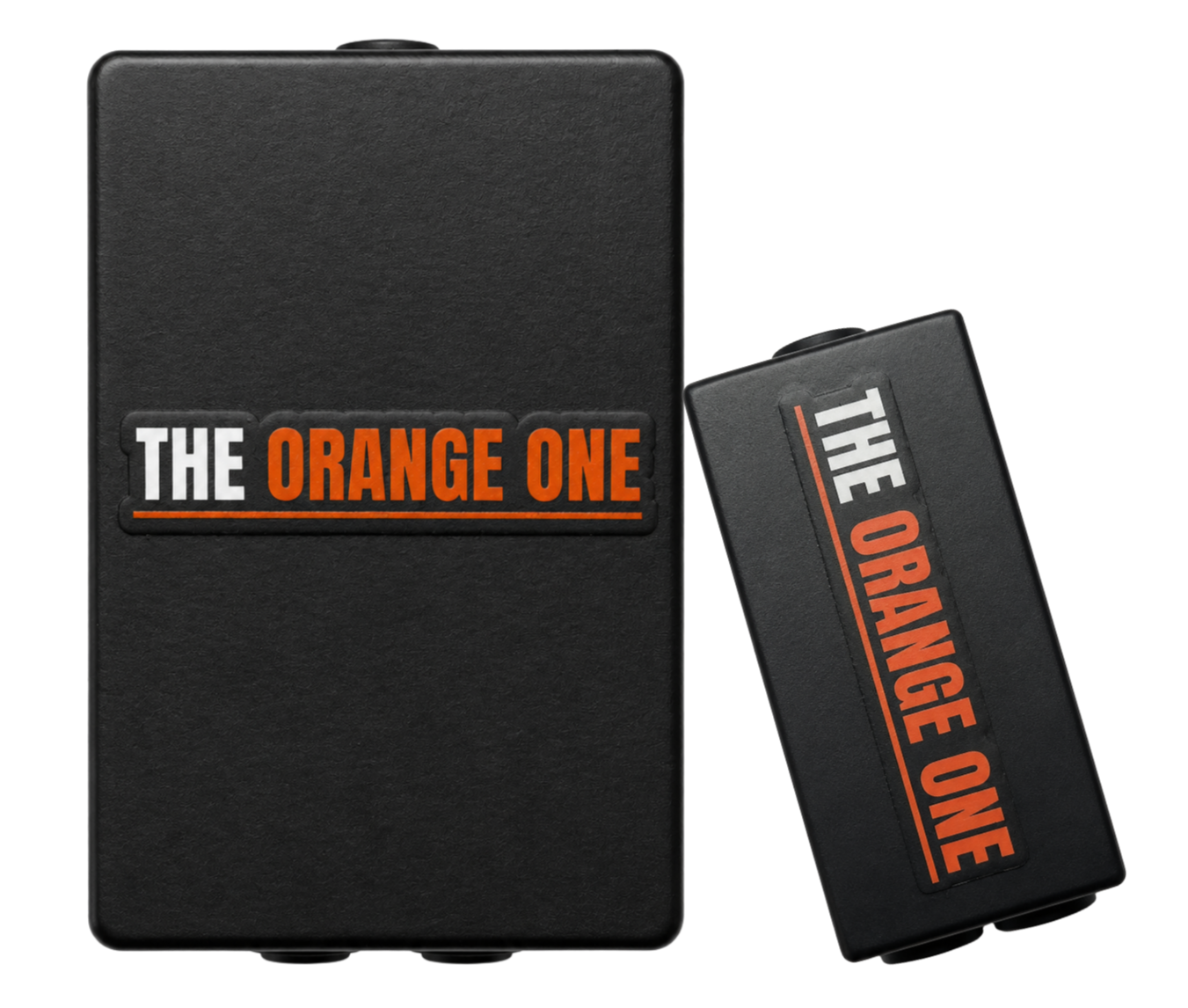
The Orange One is a Manchester made range of fully passive IFB, IEM and communications interfaces for film, television, broadcast and live production. The range includes the Original Orange One, the smaller Ezz Edition and the simplified Light Edition.The original orange one offers full comms routing and level trim controls in a rugged, compact enclosure. The orange one “Ezz” Edition provides the same control and functionality in a smaller, lighter design. For those who prefer an even simpler solution, the orange one “Light” Edition removes the routing and trim controls to provide straightforward, fixed audio summing in the same compact enclosure as the Ezz Edition - and is available in dedicated Mono or Stereo output variants.Designed with real-world production in mind, every model makes working with IFB, IEM, comms and production audio setups quicker, cleaner and less complicated, whether you are on set, on location or working at a live event.Every orange one is handmade in Manchester using high-quality components and built for the demands of everyday professional use. Three models, one dependable idea, small but mighty, whichever orange one you choose.Route it, Trim it, Hear it - Your Way!
Features Of The Orange One
Comms Routing
The Orange One gives you fast, flexible control over how IFB, IEM or Walkie-Talkie comms is routed and monitored within your setup.For a more simple set up free of controls, we also have the Light edition.Designed for real world production workflows, it allows comms and programme audio to coexist cleanly without the clutter, compromises, or awkward workarounds often found in improvised setups.
Precision Comms Trim
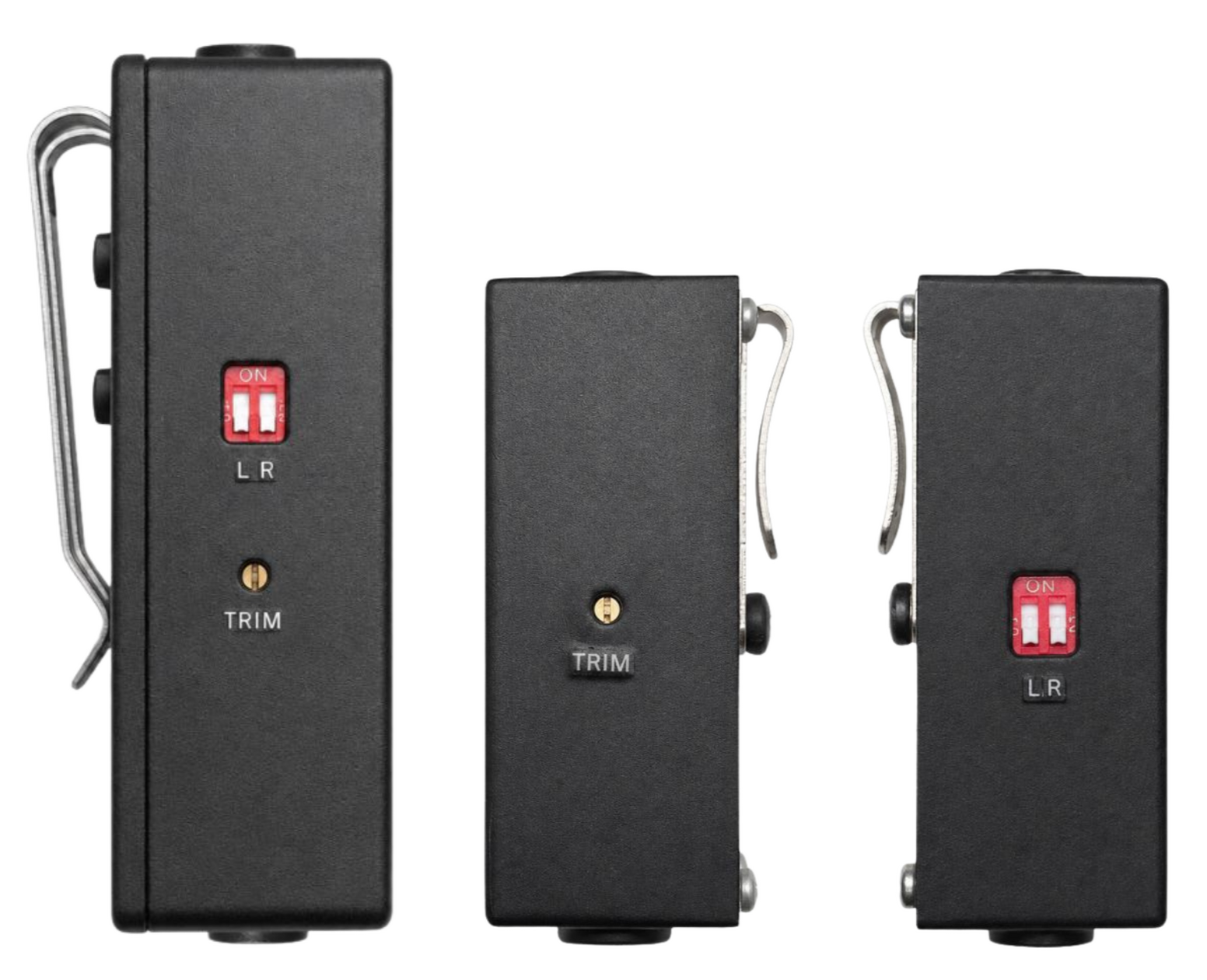
Not all comms feeds are created equal. The dedicated trim control allows you to tame harsh walkie-talkie radios, compensate for level differences, and dial in a more balanced listening experience, especially important during long days on set where comfort and clarity matter.
Fully Passive Signal Design
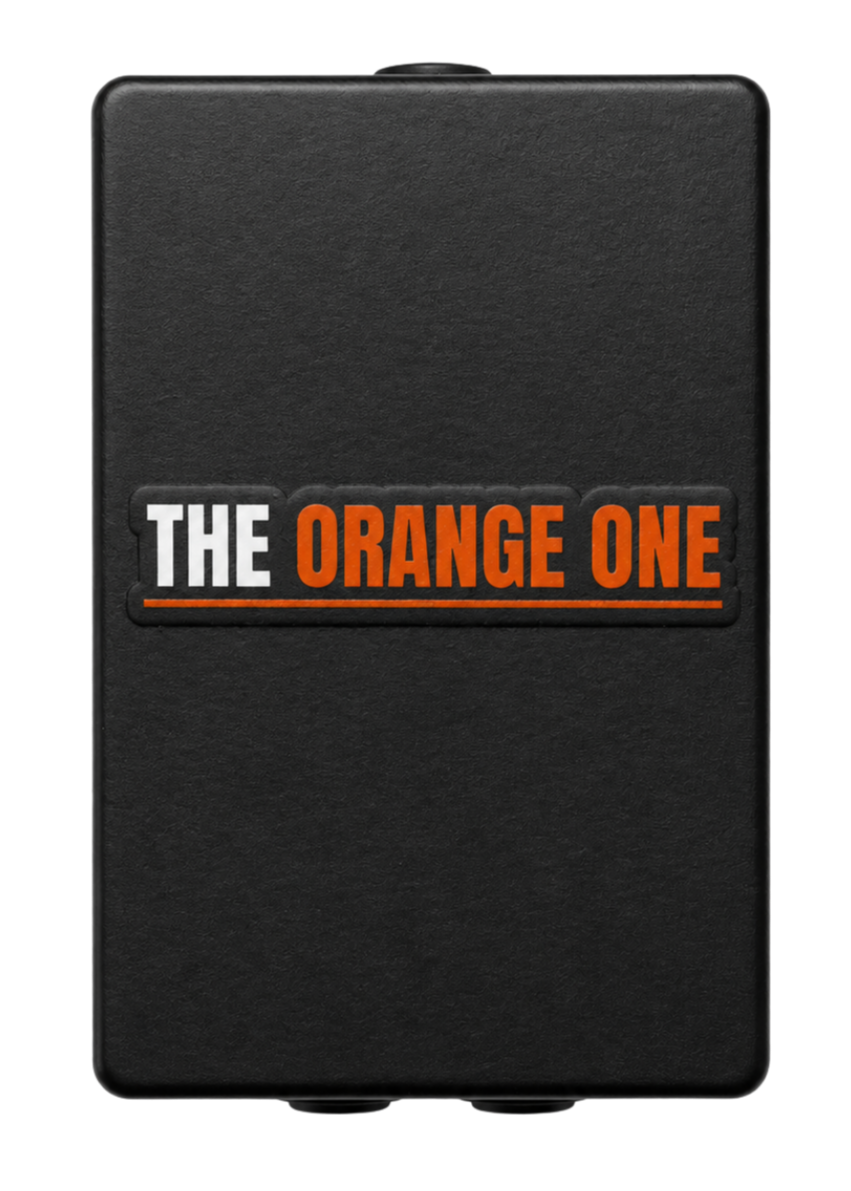
Built around a passive architecture, The Orange One delivers dependable operation without relying on power for its core functionality.No charging, no boot up time, no unnecessary complexity, just a clean, reliable audio path that is always ready to work.
Built for Production Environments
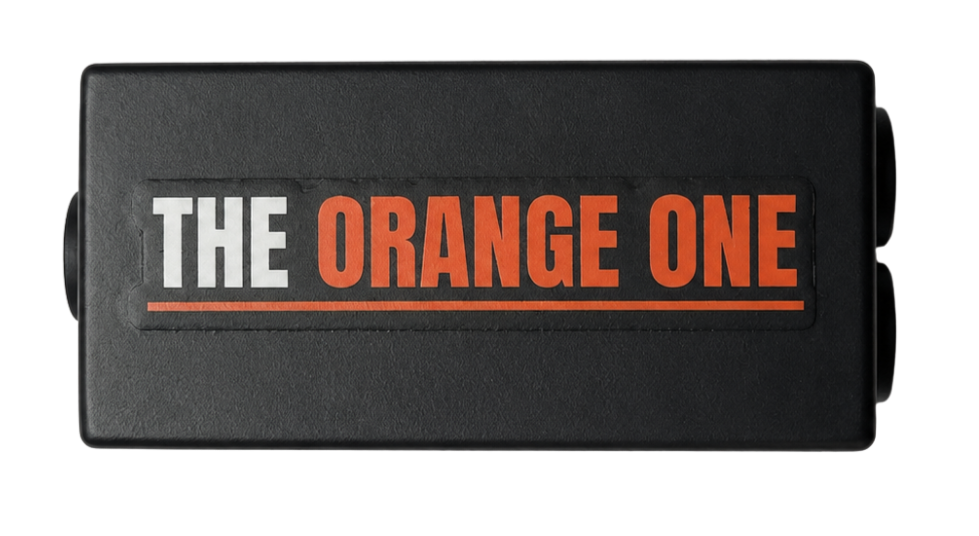
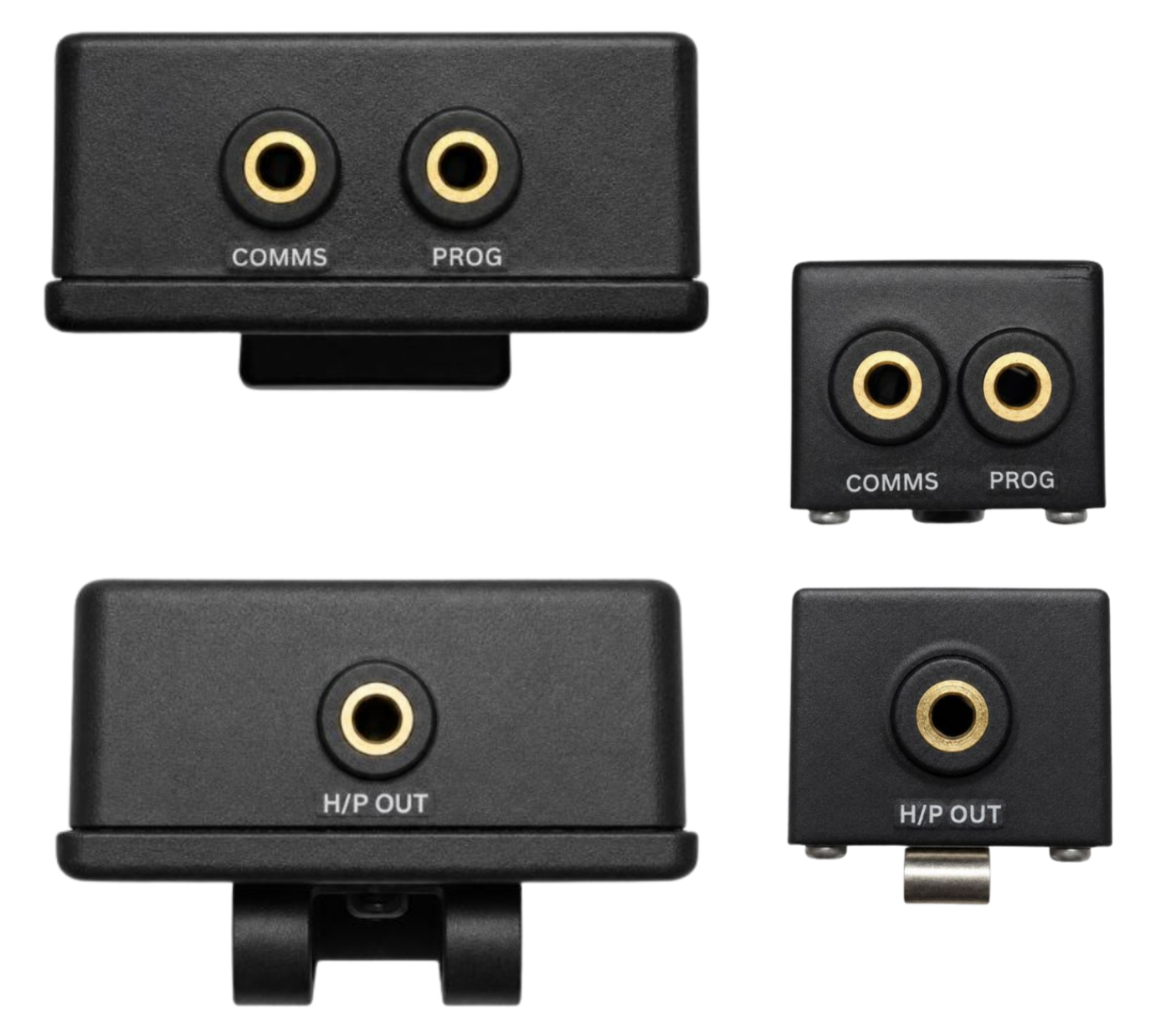
Housed in a rugged RF/EMI shielded aluminium enclosure and designed to withstand the realities of location sound work, The Orange One is made for life in bags, carts, cases, and fast-moving productions.Durable construction make it reliable when conditions are anything but.Designed to work seamlessly alongside industry standard audio and communications equipment, The Orange One fits naturally into existing workflows. Simple, adaptable, and production focused from the ground up.
Who Is This For?
It is built for production sound mixers, boom operators, utility sound technicians, broadcast crews, assistant directors, script supervisors, camera operators, and anyone needing reliable IFB and comms monitoring in fast paced production environments.
Which one is right for me?
The Orange One "Ezz" Edition
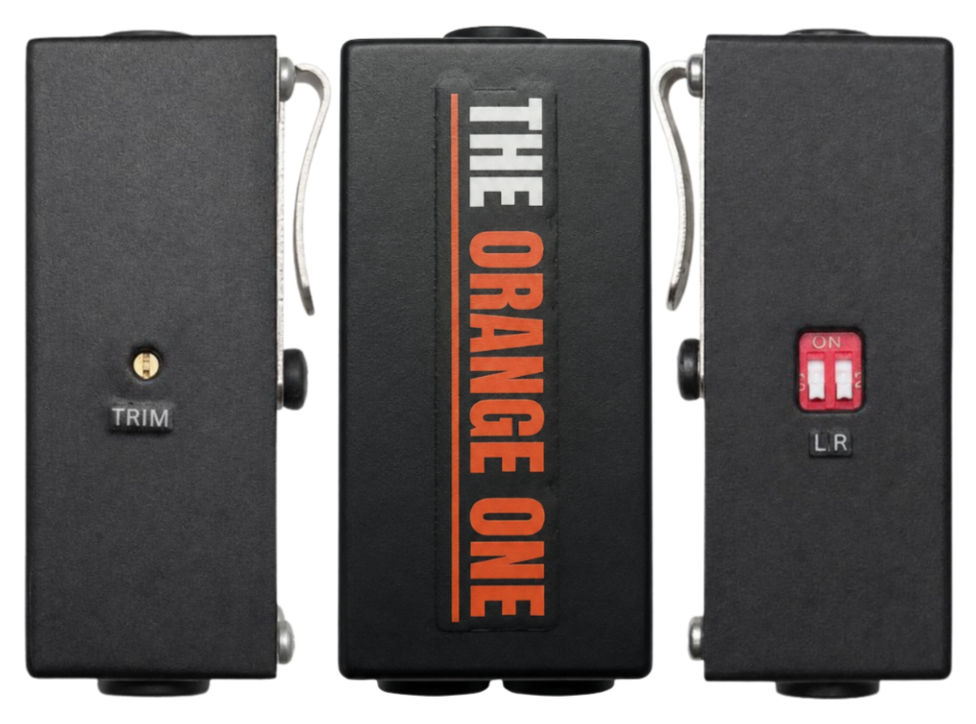
The orange one "Ezz" Edition gives production professionals more control over IFB and comms monitoring workflows, but smaller and lighter!Designed for broadcast, film, and live production environments, it allows users to route it, trim it, and hear it - their way.
| Inputs: | 2x 3.5mm TRS mini jack |
| Output: | 1x 3.5mm TRS mini jack |
| Weight: | Approx <60g |
| Dimensions: | 57mm x 29mm x 22mm |
| Housing: | RF/EMI Shielded Aluminium |
| Power: | Completely Passive |
| Warranty: | 3 years |
| Price: | £150+VAT |
| What's in the box? | 1x The Orange One "Ezz" Edition & 1x Mini flathead screwdriver for the Trim control (just in case you need it!) |
The Orange One "Light" Edition
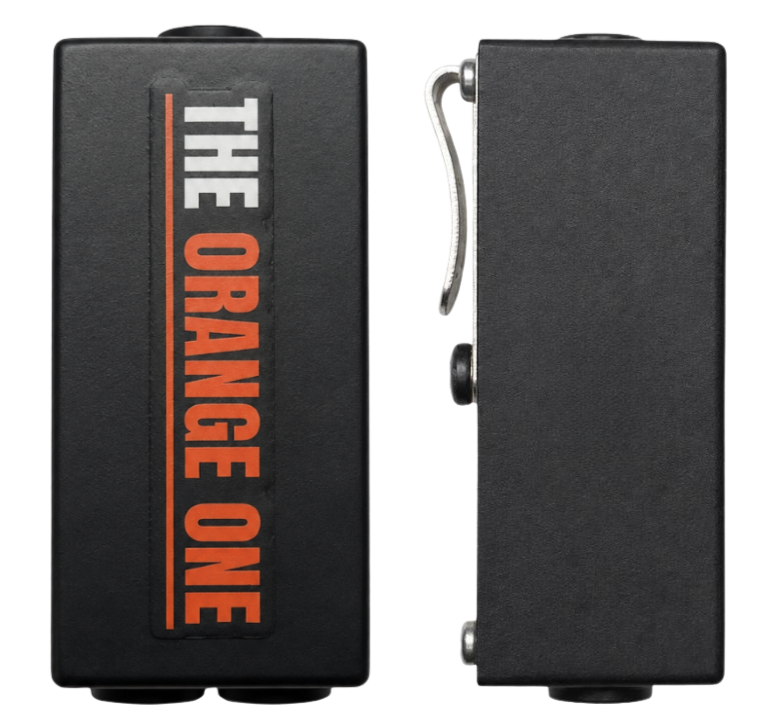
The orange one “Light” Edition gives production professionals a simple, streamlined way to combine IFB and comms audio in one compact device without the need for additional controls. It is available in either Mono or Stereo variants.The Mono variant outputs all audio to the left only, ideal for those that want an earpiece.The Stereo variant is for those that want to use a set of headphones.Designed for broadcast, film and live production, it provides straightforward, reliable monitoring without the need for additional controls.
| Inputs: | 2x 3.5mm TRS mini jack |
| Output: | 1x 3.5mm TRS mini jack |
| Weight: | Approx <60g |
| Dimensions: | 57mm x 29mm x 22mm |
| Housing: | RF/EMI Shielded Aluminium |
| Power: | Completely Passive |
| Warranty: | 3 years |
| Price: | £80+VAT |
| What's in the box? | 1x The Orange One "Light" Edition |
The Orange One Standard Edition
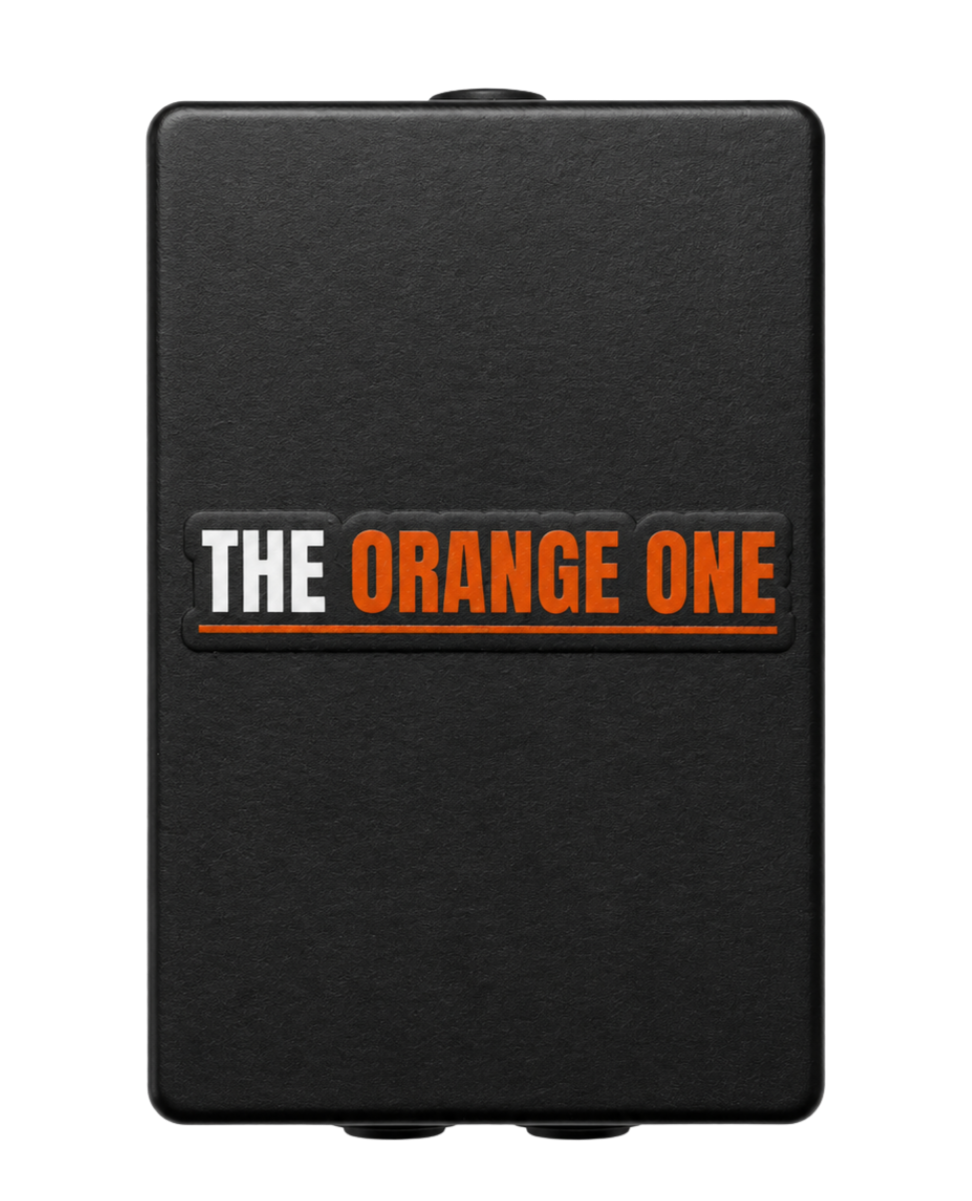
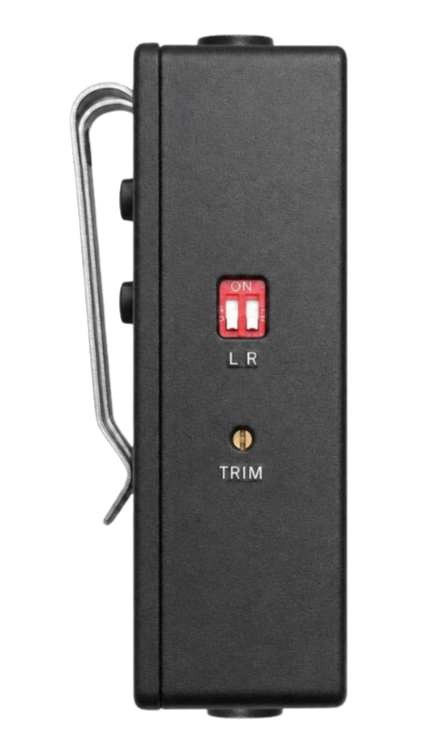
The orange one gives production professionals more control over IFB and comms monitoring workflows.A bigger and heavier option for those that want to know that it's there.Designed for broadcast, film, and live production environments, it allows users to route it, trim it, and hear it -their way.
| Inputs: | 2x 3.5mm TRS mini jack |
| Output: | 1x 3.5mm TRS mini jack |
| Weight: | Approx 115g |
| Dimensions: | 80mm x 55mm x 25mm |
| Housing: | RF/EMI Shielded Aluminium |
| Power: | Completely Passive |
| Warranty: | 3 years |
| Price: | £125+VAT |
| What's in the box? | 1x The Orange One & 1x Mini flathead screwdriver for the Trim control (just in case you need it!) |
Where to buy?
Availability for the orange one is continuing to grow, with additional retailers and distribution partners expected to join soon.Built for real-world broadcast and production workflows, the orange one helps crews route it, trim it, and hear it - their way.
UK Resellers:
EU Distributor:
New Zealand Distributor:
Australian Distributor: Coming Soon
Canadian Distributor: Coming Soon
United States Distributor: Coming Soon
What accessories are available?
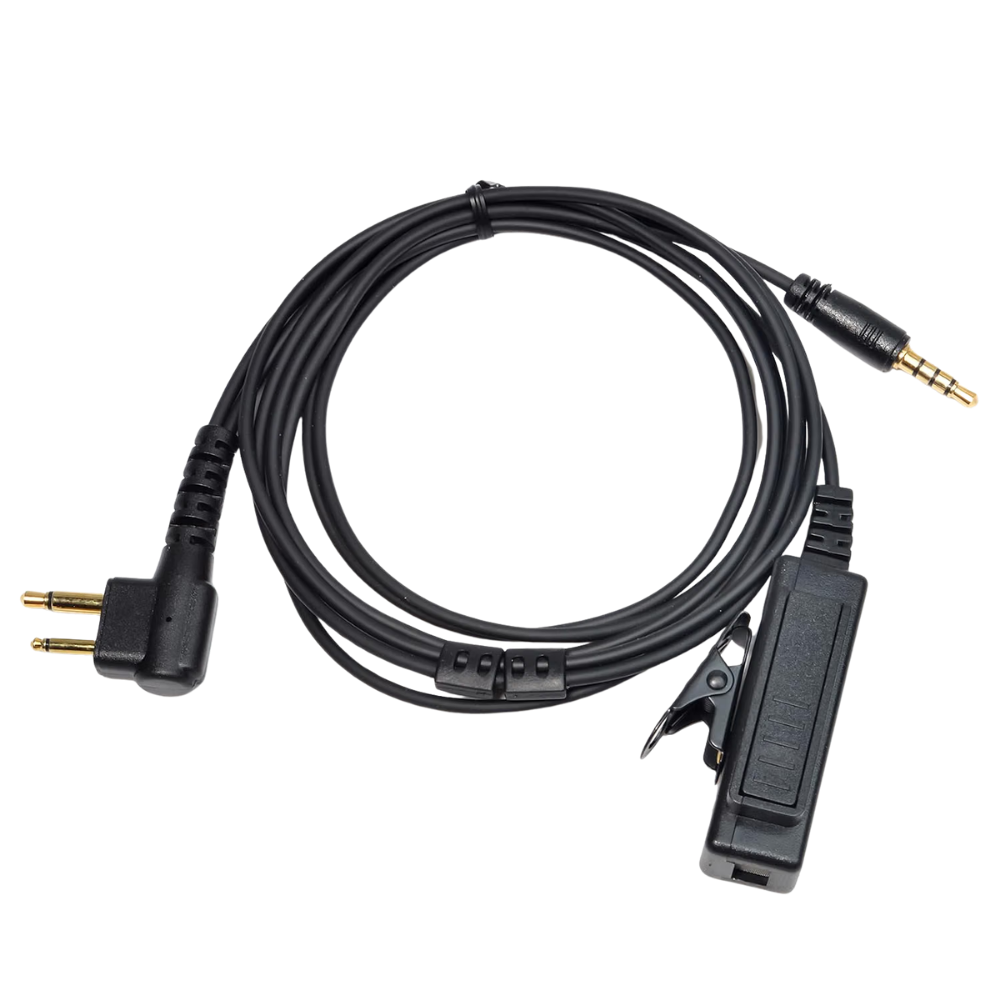
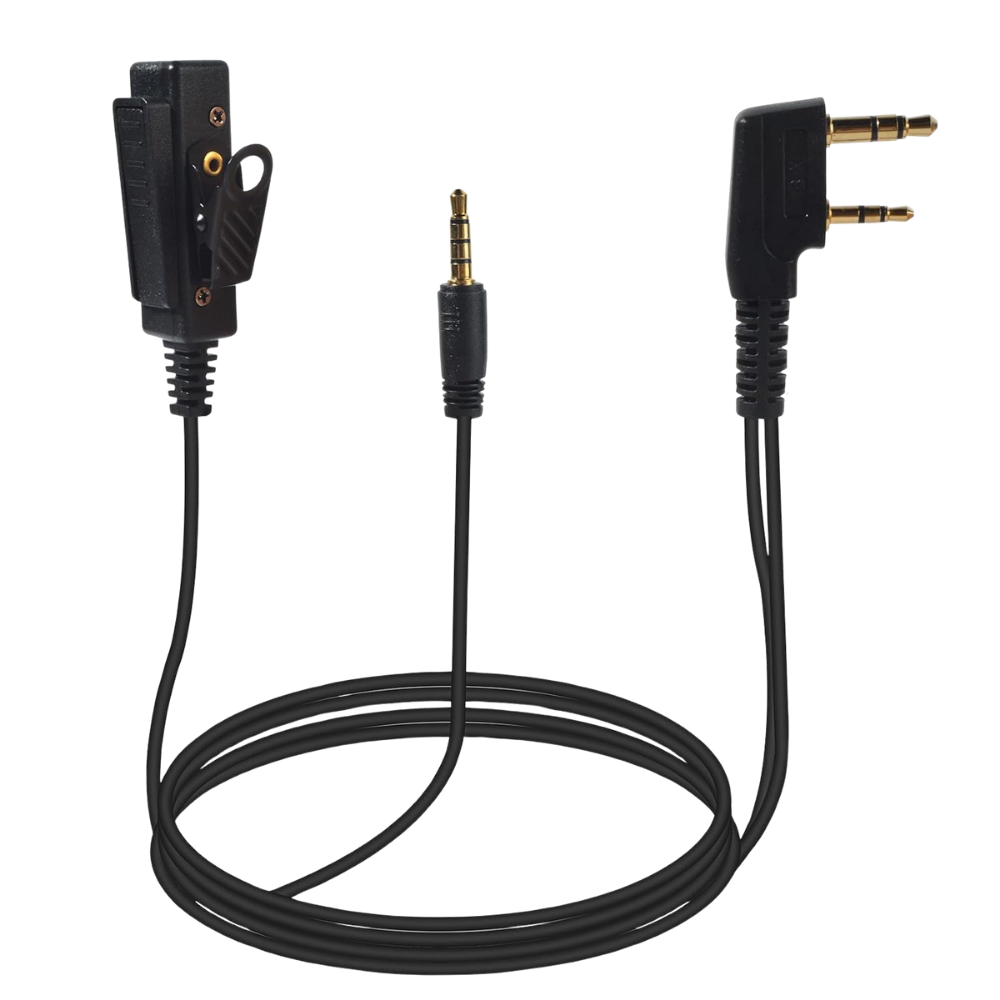
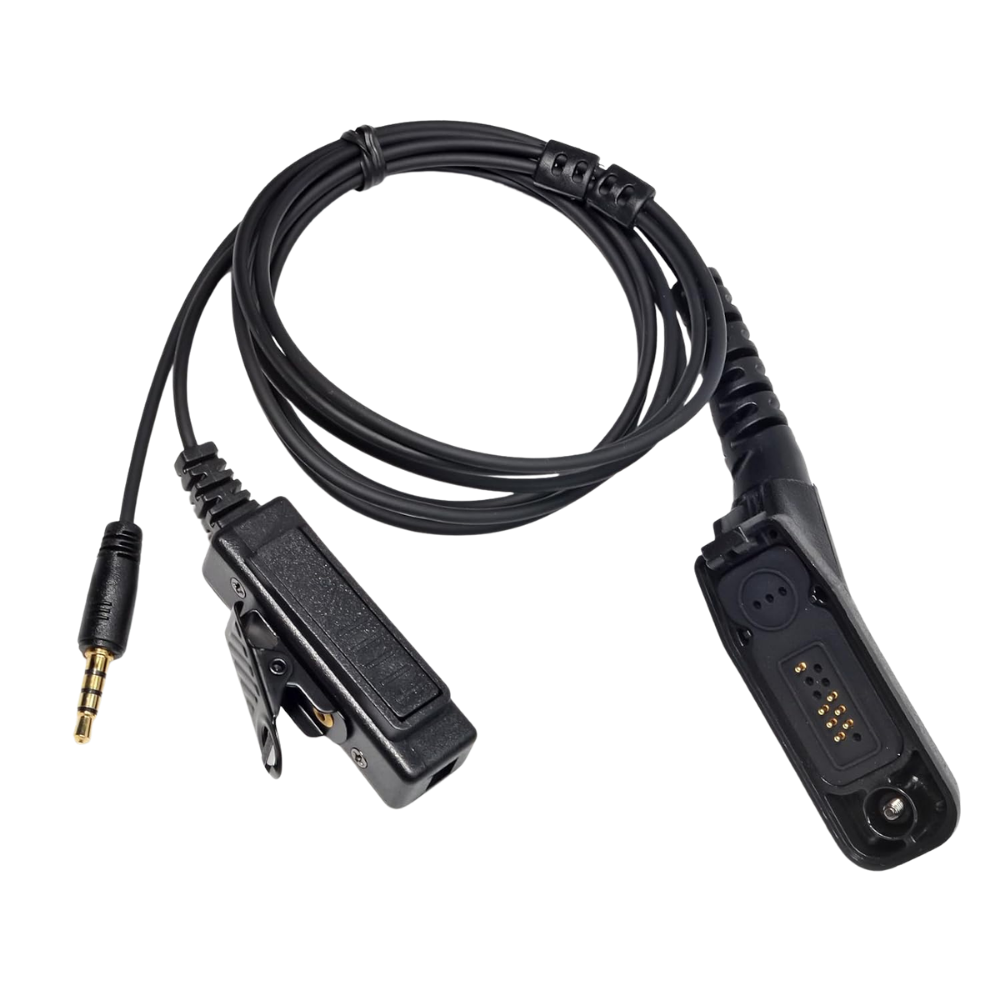
The orange one accessories range includes cable assemblies and connectivity solutions for IFB systems, walkie-talkies, comms equipment, and production monitoring workflows with more coming soon.Designed for film, television, broadcast, and live production professionals, these accessories help simplify complex audio routing setups.Each cable assembly is sold separately.

Motorola assembly
Kenwood assembly
M7 Multi-Pin assembly
Assembly compatibility:
| Motorola: | |
|---|---|
| Motorola: | All two pin models & some multi-pin models if using the correct adaptor |
| Bearcom: | All two pin models |
| Cobra: | All two pin models |
| Freidaxin: | All two pin models |
| Connect: | CS1000, CS2000 & CS3000 |
| Midland: | G15 & G18 |
| Hytera: | Limited to none locking two pin models |
| Relm: | RP6500 only |
| Tekk: | XU100, XV100, XU1000 & XV1000 |
| Yaesu: | FT4X |
| Black Box: | Blackbox, Blackbox+ & Bantam |
| Kenwood: | |
|---|---|
| Kenwood: | All two pin models & some multi-pin models if using the correct adaptor |
| Baofeng: | UV-82, BF-F8HP, UV-5R, BF-888S, UV5RA, UV-82HP, PoFung GT-3, GT-3TP radio |
| Olympia: | P324R |
| Polmar: | Easy, Easy Mimetic, Work3 & Work 4 |
| Wouxun: | KG Series |
| Quansheng: | K5, K6 & TK-11 |
| Pluxin: | 777/888, PX-3288 |
| Retevis: | All two pin models |
| Relm: | RPV416a, 516a & 599a |
| M7 MP: | |
|---|---|
| Multiple-Pin: | XPR6300, XPR6350, XPR6380, XPR6500, XPR6500, XPR6550, XPR6580, XPR7350, XPR7550, XiRP8200, XiRP8208, XiRP8260, XiRP8268, APX4000, APX4000 P25, APX6000, APX6000 P25, APX6000XE P25, APX7000, APX7000XE P25, DGP4150, DGP4150+, DGP6150, DGP6150+, DP3400, DP3401, DP3600, DP3601, DP4800, DP4801 etc |
Don't see your Walkie-Talkie listed? Contact us!
Need to get in touch? Contact us!
Blog
The Orange One in Television Sound With SAB Sound
24/09/2026Three location sound professionals on why the Standard Edition has earned a place in the bag.On a busy television production, listening is never just about programme. Sound teams need to stay across the mix while remaining connected to assistants, RF teams and the people helping a complex day run smoothly.The Orange One Standard Edition was built for that job: a compact, passive interface that combines stereo programme audio and mono communications in one headphone feed, while keeping the comms level and routing firmly in the user's hands.We are delighted to share feedback from three sound professionals who have used it in the field on major Channel 4 productions. Their comments tell the story better than we ever could.
Staying Connected When Every Voice Matters
For Sound Supervisor Stu Bruce, the value of a clear line to the team became obvious during Handcuffed - The Last Pair Standing Series 2 for Channel 4, produced by 72 Films with audio facilities supplied by SABSOUND.“I had 17 voices in my ears in this setup but the addition of clear coms from my assistants was vital and the Orange One didn't let me down - Simple, effective and sounding great making it a valuable addition to my kit and smooth running of this production.”— Stu Bruce, Sound SupervisorThat is exactly the point at which a small, purpose-built tool earns its place. The Standard Edition lets a user keep programme present while setting communications at a workable level and placing it in the left ear, right ear or both. There is no additional power requirement and no menu to work through when the day is already demanding attention elsewhere.
Clean Programme Audio Without Extra Fuss
On Gogglebox Series 28 for Channel 4 and Studio Lambert, Sound Recordist Pete Gill put the Orange One’s straightforward approach into equally straightforward words.“The Orange One by Wendy’s sounds totally clean... I’d be happy to have this little unit in my kit!”— Pete Gill, Sound RecordistThe Standard Edition is deliberately simple. It does not try to be another powered receiver, mixer or comms system. It is there to bring programme and communications together cleanly through one pair of headphones, with the control needed to make the setup useful rather than distracting.
A Compact Addition on Busy Days
The same theme came through from Sound Recordist Rory McGarrigle after using the Orange One on Celebrity Gogglebox Series 8 for Channel 4 and Studio Lambert.“A compact & mighty addition to any location sound kit. Simple, reliable and built to make busy days easier. Perfect mix of clear comms, clean programme audio and zero fuss when you need it most. Your sound kit’s missing link.”— Rory McGarrigle, Sound RecordistIt is feedback we are especially proud of because it reflects the reason the Orange One exists. When a setup needs a separate programme feed and a clear comms path, the Standard Edition gives both a permanent, practical home without adding another powered box to the bag.
The Standard Edition at a Glance
Combines stereo programme audio and mono communications through one stereo headphone output.Independent comms trim, with left-ear, right-ear or both-ear routing.Compact, completely passive design with no battery, charger or menu system to manage.Every Orange One Standard Edition is handmade in Manchester for people who need to hear the right things at the right time. Thank you to Stu, Pete and Rory for putting it to work and for sharing their experiences.
Tested on Set: Tom Wilkin Reviews The Orange One Ezz Edition
06/09/2026There is no better test for a piece of sound equipment than long days on a busy production and no better compliment than earning a regular place on someone’s work belt.We were delighted to see experienced First Assistant Sound and Boom Operator Tom Wilkin share his thoughts on The Orange One Ezz Edition.With more than ten years working across feature films, high-end television and commercials, Tom’s credits include productions such as The Fantastic Four: First Steps, Wrath of Man and 1917.He knows exactly what professional sound equipment needs to deliver in the demanding environment of a working set.
Small in size, big on practicality
Tom has been using his Ezz Edition every day while working on a Netflix production, putting it through exactly the kind of real-world use it was designed for.Here is what he had to say:“Recently added The Orange One Ezz Edition to my work belt and I’ve been seriously impressed with it.I’m currently using it every day on a Netflix production and, for me, the biggest win is the size. It’s tiny and incredibly lightweight compared with other comms combiners I’ve used, but still gives me all the flexibility I need on set.Two inputs, independent comms trim, left/right routing and a stereo output all in a completely passive little box weighing under 60g. No batteries, no charging and nothing unnecessary hanging off the belt.When you’re wearing your kit for 10–12+ hours a day, anything that reduces bulk without compromising functionality is a winner.Even better, they’re handmade in Manchester and built specifically with film, TV and broadcast workflows in mind.Really nice bit of kit and one I can genuinely see staying on my belt.”
More control without more bulk
Measuring just 57 × 29 × 22mm and weighing approximately 60g, the Ezz Edition was created for professionals who need greater control over their monitoring without adding unnecessary weight to their kit.It combines a mono comms source with stereo programme audio and provides independent comms trim, left/right routing and a stereo headphone output. Its completely passive design means there are no batteries to charge, while the RF/EMI-shielded aluminium enclosure helps make it suitable for demanding film, television and broadcast environments.Most importantly, it is small enough to remain comfortably on your belt throughout those long production days.A huge thank you to Tom for taking the time to share such thoughtful feedback and for putting the Ezz Edition properly through its paces on set.Handmade in Manchester. Small but mighty. 🍊
The Orange One Heads to New Zealand – Broadtech Limited Announced as Official Distributor
01/09/2026We’re delighted to announce that Broadtech Limited are now an official New Zealand distributor for The Orange One range.It’s another exciting step forward for a product that started life as a simple idea here in Manchester – create a small, practical passive audio solution that gives production professionals more control over what they hear.Now, The Orange One is heading to New Zealand.
A Perfect Fit for The Orange One
Broadtech has a long-established presence within New Zealand’s broadcast, professional audio, television, film and media industries, making them a natural home for The Orange One range.Their team works with professionals across broadcast and production, supplying and supporting specialist equipment and technical solutions throughout New Zealand and the wider Pacific region.For us, finding the right distributor has never simply been about getting products onto shelves.We want to work with companies that understand the people actually using the equipment and Broadtech does exactly that.
The Orange One Range
New Zealand customers will now have a local route to access The Orange One family:The Orange One – Standard Edition
Our original passive comms and programme combiner, giving users independent comms trim and left/right routing control alongside a stereo programme feed.The Orange One – Ezz Edition
The same core functionality and control of the Standard packed into our much smaller enclosure – ideal when size and weight really matter.The Orange One – Light Edition
Our stripped-back, straightforward option for users who simply need to combine their audio sources without the additional trim and routing controls.Every Orange One is handmade in Manchester, UK, individually assembled and tested before it leaves us.No batteries.
No charging.
No complicated setup.Just plug in, route it, trim it and hear it your way.
From Manchester to New Zealand
Seeing The Orange One make its way into more production environments around the world is something we’re incredibly proud of.What began as a small handmade product designed to solve a very specific real-world problem is steadily finding its way into the hands of sound professionals, production crews and broadcasters much further afield than we originally imagined.Having an experienced company like Broadtech representing the range in New Zealand is another important milestone for us.Most importantly, it gives New Zealand customers access to local knowledge, local support and a local supplier rather than having to purchase directly from the UK.We’d like to say a huge thank you to the team at Broadtech Limited for coming on board and supporting what we’re building.We’re looking forward to seeing plenty more little orange boxes appearing on productions across New Zealand.🍊 Small box. Big journey.The Orange One – Handmade in Manchester. Now available through Broadtech Limited in New Zealand.
The Orange One Ezz Edition Passes the “Clumsy Idiot Test”
01/09/2026How much equipment can you add to an on-set pouch before the whole thing becomes a game of Buckaroo?That was the brilliantly relatable question behind Erin Elston’s recent review of The Orange One Ezz Edition. When space and weight both matter, every piece of equipment has to earn its place. It needs to be compact, dependable and genuinely useful—not simply another box to carry.After putting the Ezz Edition through its paces, Erin’s verdict was everything we designed it to achieve: full functionality in a seriously compact package.
Small enough for the pouch, useful enough for the job
The Ezz Edition is a passive IFB, IEM and comms interface designed for production sound and broadcast professionals who want to hear mono production comms alongside a stereo programme feed through a single pair of headphones.There are no batteries, charging cables or external power supplies to worry about. Simply connect the mono comms source, connect the stereo programme source and take the combined signal from the headphone output.Despite measuring only 57×29×22mm and weighing approximately 60g, the Ezz Edition retains the controls that make The Orange One so useful on set.Erin highlighted the ability to route comms to the left or right ear, as well as the recessed TRIM control for adjusting the comms level to suit different sets and working environments.Her assessment was wonderfully concise:“Full-on functionality. Tick.”Comms can also be routed to both ears, giving each user the freedom to choose the arrangement that works best for them.
Compact without feeling delicate
Making something smaller is only worthwhile if it remains tough enough for everyday professional use.The Ezz Edition is built inside an RF-shielded cast-aluminium enclosure, with secure 3.5 mm connections and a strong metal belt clip. Erin found that it fitted comfortably onto her belt or pouch without adding the weight she had expected from something containing this much functionality.In her words, it is “lightweight and really compact.” More importantly, she felt the unit and its inputs were sturdy and properly made.That matters. Location and broadcast equipment is handled constantly, clipped onto clothing, packed into bags and moved between jobs. It cannot merely look good on a workbench; it has to inspire confidence when it is being used for real.The all-important “clumsy idiot test”Erin’s final test was a simple one: could it survive her?Although the secure belt clip makes an accidental drop unlikely, she felt the Ezz Edition was sufficiently solid and well constructed that she would not expect it to break if it did fall from her belt or pouch.We would probably describe that as a real-world durability assessment. Erin’s name for it is much better: the “clumsy idiot test.”It passed.
The final verdict
Erin concluded her review with:“All in all, a gorgeous piece of kit.”Feedback like this means a great deal to us because every Orange One is handmade in Manchester. The Ezz Edition was created for people who want more control over their monitoring without sacrificing valuable pouch space, and it is brilliant to hear that it is doing exactly that in the real world.Thank you, Erin, for taking the time to test it and share such a thoughtful and wonderfully entertaining review.
Which Orange One Is Right for You? Standard vs Ezz vs Light
21/08/2026Three models. Three different ways to work. One small but mighty idea.Every model in The Orange One range is designed to solve the same basic problem: how do you listen to communications and programme audio through one headset or earpiece without making your setup unnecessarily complicated?The answer depends on how much control you want, how small you need the unit to be and whether you use stereo headphones or a single mono earpiece.So, which Orange One is right for you?
What Do All Three Models Have in Common?
The Orange One, Ezz Edition and Light Edition are all completely passive IFB, IEM and communications interfaces.Each model allows a communications source such as a walkie-talkie, two-way radio or suitable production comms output to be combined with a programme source from an IFB receiver, IEM receiver, mixer or other monitoring device.Both sources can then be heard through one connected headset, pair of headphones or suitable earpiece.There are no batteries to charge, no menus to navigate and no external power supply required. Every model is housed in an RF/EMI shielded aluminium enclosure and handmade in Manchester for professional film, television, broadcast, location sound and production audio workflows.The difference is how much control each model gives you and how much space it takes up in your kit.
The Original Orange One
The original Orange One is the full-size model and the one that started it all.It features an adjustable COMMS TRIM control, allowing harsh or excessively loud radio audio to be reduced until it sits more comfortably alongside the programme feed.Its routing control also allows the communications audio to be sent to the left ear, right ear or both ears. This gives you greater freedom to decide exactly how your communications and programme audio are presented.For example, you might want programme audio in stereo with the walkie routed to both ears. Alternatively, you may prefer to keep the walkie isolated on one side while leaving the other ear clearer for programme audio.Measuring approximately 80 × 55 × 25mm and weighing around 115g, the original is larger than the other two models. However, some users prefer its more substantial enclosure, traditional belt clip and rugged powder-coated finish.Choose the original Orange One if:You want adjustable communications level control.You want to route comms left, right or to both ears.You prefer a larger, more substantial unit.Minimum size and weight are not your main priorities.You want the full Orange One functionality for £125 plus VAT.For sound mixers, boom operators, utilities and production crew who want maximum control in a rugged full size enclosure, the original remains an excellent all rounder.
The Orange One Ezz Edition
The Ezz Edition offers the same core TRIM and routing functionality as the original Orange One but squeezes it into a much smaller enclosure.At approximately 57 × 29 × 22mm and around 60g, it is almost half the weight of the original and occupies considerably less space in a sound bag, pouch or personal monitoring setup.You still get the adjustable COMMS TRIM control and the ability to route communications left, right or to both ears. The Ezz is not a simplified version of the original; it is the same essential functionality in a smaller and lighter package.That makes it particularly useful for boom operators, sound utilities, camera operators and anybody already carrying enough equipment around for a long production day.Choose the Ezz Edition if:You want the full TRIM and routing functionality.You need the smallest and lightest controllable model.Space in your sound bag or pouch is limited.You are building a lightweight body-worn monitoring setup.Compactness is more important to you than having a larger enclosure.The Ezz Edition costs £150 plus VAT and is handmade to order. It is the premium compact choice for people who want more control without more bulk.Small box. Full control. Ezz by name and easy by nature.
The Orange One Light Edition
The Light Edition is for users who like the basic Orange One idea but do not need adjustable TRIM or communications routing.It combines the communications and programme sources using a straightforward fixed passive arrangement. There are no controls to adjust: simply connect your sources, connect your earpiece or headphones and get on with the job.The Light uses the same compact 57 × 29 × 22mm enclosure as the Ezz Edition and weighs approximately 60g.It is available in two dedicated versions: Mono and Stereo.
Light Edition Stereo:The Stereo version is designed for users monitoring through stereo headphones, earphones or IEMs. It retains the stereo programme feed while adding the mono communications audio.
Light Edition Mono:The Mono version is intended for use with a single mono earpiece. It combines the required audio into a suitable mono monitoring feed without needing additional switches or controls.Choose the Light Edition if:
You simply need to hear communications and programme audio together.
You do not require adjustable comms TRIM.
You do not need to change the comms routing.
You want the smallest and most affordable Orange One.
You already know whether your setup requires a Mono or Stereo output.At £80 plus VAT, the Light Edition is the simplest and most affordable member of the family.No tweaking. No fiddling. Just connect it and carry on.
The Quick Comparison
Choose the original Orange One if you want full TRIM and routing control in a larger, rugged enclosure.Choose the Ezz Edition if you want the same full control in the smallest and lightest possible package.Choose the Light Edition if you only need straightforward audio combining without adjustable controls.If you use a single mono earpiece, choose the Light Edition Mono.If you use stereo headphones, earphones or IEMs and do not require controls, choose the Light Edition Stereo.If you want to adjust the comms level or decide whether it is heard on the left, right or both sides, choose either the original Orange One or the Ezz Edition.
There Is No Wrong Flavour
The best Orange One is not necessarily the biggest, smallest or most expensive model. It is the one that fits naturally into your particular equipment and workflow.Some people want the substantial feel and rugged finish of the original. Others want every millimetre and gram removed from their kit, making the Ezz the obvious choice. Some simply want their two audio sources brought together with no additional controls which is exactly why the Light Edition exists.Whichever flavour suits you, every Orange One shares the same basic philosophy: professional monitoring should be straightforward, dependable and designed around the person using it.The Orange One range is available in the UK from Wendy’s Broadcast Services Ltd, Soundkit Ltd, Raycom Ltd and Pinknoise Systems, with European availability through VDB Audio.Three models. One dependable idea.Route it, Trim it, Hear it - Your way!
Small-Batch. Serious Standards. The Orange One Range Is Now Compliance Documented
21/08/2026We have always said that The Orange One is small but mighty. Now the paperwork behind it is just as serious as the little black boxes themselves.We are pleased to confirm that the current controlled production versions of The Orange One Standard Edition, Ezz Edition and Light Edition family are now backed by their own formal technical documentation and model-specific Declarations of Conformity.In plain English: the range has been properly assessed, documented and brought under a controlled compliance system for the applicable UK and European requirements.What has been completed?Each model now has a controlled technical file covering its design, construction, materials, manufacturing process, product markings, safety information, risk assessment, quality-control procedure and serial-number traceability.Separate Declarations of Conformity cover:The Orange One Standard Edition - SKU TOO-ORANGEONEThe Orange One Ezz Edition - SKU TOO-ORANGEONE-EZZThe Orange One Light Edition Mono - SKU TOO-ORANGEONE-LIGHT-MThe Orange One Light Edition Stereo - SKU TOO-ORANGEONE-LIGHT-SThe current designs have been assessed against the applicable EU RoHS requirements under Directive 2011/65/EU, as amended, using EN IEC 63000:2018 as the technical documentation standard. Corresponding Great Britain RoHS requirements are also addressed.The declarations are manufacturer Declarations of Conformity the correct conformity route for these completely passive products. They are not claims of third party certification, and no notified body was required.
WEEE registered and responsibly marked
Wendy's Broadcast Services Limited is registered as a UK small producer of electrical and electronic equipment under producer registration number WEE/MM4413AA.Current production units carry the required product identification and disposal markings, including the crossed out wheeled bin symbol. Supporting recycling and disposal information is also provided so that products can be handled responsibly at the end of their working life.Built by hand. Backed by evidence.Every current production Orange One is handmade in Manchester, individually serial numbered and checked before it leaves us. Our production records link each unit to its model, controlled build specification and final QC result.The compliance process has formalised the care that already goes into every unit. It gives customers, retailers and distribution partners a clear, traceable record of what the product is, how it is made and the requirements against which it has been assessed.For products supplied directly by Wendy's Broadcast Services Limited to VDB S.A., VDB acts as the EU importer, supporting the established route into the European market.
Same useful little box. Even stronger foundations.
Nothing about the reason for The Orange One has changed. It is still a simple, completely passive way to combine communications and programme audio into one practical monitoring feed. There are no batteries, no charging and no unnecessary complication just more control over what you hear.What has changed is the strength of the documentation behind it.Small-batch does not mean informal. Handmade does not mean untraceable. The Orange One range is now supported by controlled technical files, formal Declarations of Conformity, WEEE registration, permanent product markings and documented final QC.That is one more reason to trust the small box doing a mighty job.Route it. Trim it. Hear it - your way!
The Orange One Goes European - VDB Audio Appointed Official European Distributor
06/08/2026We’re incredibly pleased to announce an important new chapter for The Orange One.VDB Audio has been appointed the official European distributor for The Orange One range, bringing our Manchester-made passive IFB, IEM and comms solutions to even more production sound professionals across Europe.For a little black box with a bright orange name, it’s quite a big step.But more importantly, we think we’ve found exactly the right people to take it with us.If you work in production sound, there’s a good chance the VDB name already means something to you.Based in France, VDB has been part of the professional location-sound industry since 1984, but its story began long before it became the distributor and technical specialist that it is today.The family company was founded by Georgina and Stéphane Van den Bergh. Stéphane was an experienced boom operator who saw a very practical problem with the equipment of the time: microphone boom poles were heavy.Drawing inspiration from the lightweight carbon-fibre fishing rods he used outside of work, he set about developing something better for his own job.According to VDB's own history, the result was the world’s first carbon fibre microphone boom pole.What began as a solution to a real problem experienced by a working sound professional developed into VDB Boompoles, with products that would go on to be used by sound professionals around the world.That story particularly resonates with us.The Orange One was also created around a very simple idea: identify an everyday problem faced by production sound crews and build a practical piece of equipment that makes the job a little easier.Different products. Different decades. Very similar thinking.Over the four decades since its foundation, VDB has grown far beyond its original boom poles.Today, VDB Distribution specialises in professional field and location sound equipment, representing and supplying products from some of the most established manufacturers in our industry.Its distribution portfolio has included names such as Sanken, Sound Devices, Audio Limited, Tentacle Sync, Bubblebee Industries, URSA Straps, ORCA Bags and Radius Windshields, alongside a wider catalogue of professional sound equipment.But VDB isn't simply about selling boxes.The company provides technical advice, custom cable manufacturing, research and development services, maintenance and repair facilities. VDB is also an authorised repair centre in France for a number of major professional audio manufacturers, with its technical workshop drawing on more than 30 years of experience repairing and maintaining professional sound equipment.Today its operations include its Paris shop and maintenance centre, together with its dedicated boompole workshop in Pau, France.That combination of heritage, hands-on technical knowledge and a genuine understanding of how sound professionals actually work made VDB a natural partner for us.The appointment means VDB Audio will provide an established European distribution route for The Orange One range, helping us make the products more accessible to sound professionals throughout Europe.The complete Orange One family now consists of three different versions designed around different users and workflows:The Orange One; the original full-size model, providing a passive way of combining mono comms with a stereo programme feed while giving the user adjustable COMMS TRIM and flexible left/right comms routing.The Orange One Ezz Edition; all the core TRIM and routing functionality of the original Orange One packed into a much smaller 57 × 29 × 22 mm aluminium enclosure weighing approximately 60g. Small but mighty.The Orange One Light Edition; the simplest member of the family. The same compact format as the Ezz Edition, but without the TRIM and routing controls for users who simply want a straightforward passive summing solution. The Light is available in both Mono and Stereo versions.All three are completely passive, require no batteries or external power and are designed specifically around real world professional broadcast, film, television, location sound and production workflows.And every Orange One continues to be handmade in Manchester by Wendy’s Broadcast Services Ltd.One of the things we like most about working with VDB is the shared philosophy behind the two brands.VDB's story began with a sound professional looking at the equipment he used every day and thinking, essentially, “there has to be a better way of doing this.”More than 40 years later, that same practical, user led approach to equipment design remains incredibly relevant.The Orange One comes from much the same place.It isn't designed to make a production workflow more complicated. It's designed to solve a very specific problem, sit quietly in your kit and do its job.Route it, Trim it, Hear it – your way!Having The Orange One represented in Europe by a company with VDB's history, technical expertise and reputation within the professional sound community is something we're genuinely proud of.From a handmade product developed in Manchester to a growing family of Orange Ones heading out into the wider world, things are certainly getting a little more....continental.We'd like to say a huge merci to the team at VDB Audio, and we're looking forward to seeing where this next part of The Orange One story takes us.For European availability and ordering information, visit VDB Audio at https://vdbaudio.comThe Orange One × VDB Audio
Manchester made. Europe bound. 🍊
Introducing the Orange One Ezz Edition: Same Control, Smaller and Lighter
22/07/2026The orange one has always been designed to make professional audio monitoring simpler. Now, for those who want the same dependable functionality in the smallest possible package, we are pleased to introduce the new Ezz Edition.Measuring just 57 × 29 × 22mm and weighing less than 50g, the orange one Ezz Edition is considerably smaller and lighter than the standard model without sacrificing any of the functionality or control that makes the orange one so useful.The Ezz Edition remains a fully passive IFB, IEM and comms interface designed for film, television, broadcast and live production audio.Just like the standard orange one, it combines a mono communications source such as a walkie-talkie, radio or production comms system with a stereo programme feed from an IFB receiver, IEM receiver, mixer or other monitoring source.Users still get the same adjustable comms TRIM control and flexible left, right or both-ear comms routing. There are no batteries to charge, no menus to navigate and no external power supply required.The only differences are the dimensions and weight.Why Make the Orange One Even Smaller?Professional sound bags, utility pouches and personal monitoring setups can become crowded very quickly. Every gram and every millimetre can make a difference, particularly for boom operators, utility sound technicians, camera operators and other crew members carrying equipment throughout a long working day.At less than 50g, the orange one Ezz Edition takes up minimal space and adds very little weight to a working kit. Its compact 57 × 29 × 22mm enclosure makes it ideal for users who want the smallest and lightest possible passive comms and programme audio combiner.Standard or Ezz Edition?
The introduction of the Ezz Edition does not replace the standard orange one. Both versions offer the same core functionality, passive operation and straightforward control.Some professionals prefer the more substantial feel and familiar dimensions of the standard model. Others prioritise minimum size and weight, particularly when working with compact pouches, tightly packed sound bags or lightweight personal monitoring systems.The choice is not between more or less functionality. It is simply about which size best suits your equipment, workflow and personal preference.Whether you choose the standard model or the new Ezz Edition, you still get the practical comms routing, adjustable TRIM control and dependable passive performance of the orange one.Handmade in Manchester
Every orange one Ezz Edition is handmade to order in Manchester using high-quality components and is built for the demands of professional production sound.The Ezz Edition is available to order now for £150 + VAT, with an estimated lead time of 2–3 working days, depending on demand.You can order the orange one Ezz Edition from Wendy’s Broadcast Services, Soundkit, Raycom and Pinknoise Systems.Route it, Trim it, Hear it – Your way!
The Orange One Is Now Shipping Across the UK
19/06/2026We are delighted to announce that the orange one is now shipping throughout the UK.After months of development, testing and valuable feedback from working sound professionals, finished units are now leaving our authorised UK retailers and making their way into film, television, broadcast and location sound workflows.The orange one is now available to order from:Wendy’s Broadcast Services Ltd, Pinknoise Systems, Raycom Ltd and Soundkit LtdCustomers can order directly from their preferred retailer, making it easier to purchase The Orange One from an established professional broadcast and production sound supplier.The orange one is a passive IFB, IEM and comms combiner designed for production professionals who need to monitor communications and programme audio through a single pair of headphones.A mono comms or walkie-talkie feed can be combined with a stereo programme, IFB or IEM source, reducing the need for multiple earpieces or complicated monitoring setups.The comms signal can be routed to the left ear, right ear or both ears, while the adjustable trim provides greater control over loud or harsh radio audio.This allows each user to create a monitoring setup that suits their role, their equipment and the way they prefer to work.Route it, Trim it, Hear it – Your way!Because the orange one is completely passive, it does not require batteries, charging or a separate power supply.Simply connect the programme source, comms feed and headphones, then adjust the routing and comms level to suit the production environment.Its straightforward design makes the orange one a practical option for sound trainees, sound assistants, boom operators, production sound mixers, camera crews, directors, producers and other professionals who need to remain connected while monitoring programme audio.Every orange one is handmade in Manchester and assembled with professional production use in mind.The compact and lightweight design makes it easy to add to an existing sound bag, belt or production setup without introducing another powered device that needs to be charged or maintained.From the beginning, the goal of the orange one has been simple: to give production professionals More Control over the way they monitor comms and programme audio.The orange one is now shipping from Wendy’s Broadcast Services Ltd, Pinknoise Systems, Raycom Ltd and Soundkit Ltd.To find your preferred retailer and learn more about the product, visit the Where to Buy section at theorangeone.co.uk.More Control.Route it, Trim it, Hear it – Your way!
Sabina Aslam Puts the Orange One Through Its Paces
05/06/2026Real world testing has been an important part of developing The Orange One.Rather than relying solely on workshop testing, we wanted working sound professionals to use pre-production units in genuine film and television environments. This allowed us to see how the orange one performed during long production days, changing locations and the everyday demands of working on set.One of the professionals helping us with this process was Sabina Aslam, a sound trainee who has worked on productions including After the Flood and House of Guinness.Sabina has been working alongside production sound mixer Martin Beresford on a feature filming in the North of the UK, where she has been using a pre-production version of the orange one as part of her working setup.Sound trainees, assistants and boom operators often need to monitor more than one audio source while working.Programme audio may be coming from an IFB or IEM receiver, while important production communications are being received through a separate walkie-talkie or comms system. Monitoring both can mean wearing multiple earpieces or using equipment that offers very little control over how each source is heard.The orange one was developed to provide a simpler and more flexible solution.It combines a mono comms feed with a stereo programme, IFB or IEM feed, allowing both sources to be monitored through a single pair of headphones.The orange one allows the comms signal to be routed to the left ear, right ear or both ears. This gives the user the freedom to choose how communications sit alongside the programme audio.The adjustable comms trim can also be used to reduce loud or harsh radio audio, helping the user achieve a more comfortable balance between their comms and programme feeds.Because the orange one is completely passive, there are no batteries to replace, no charging to remember and no external power supply required.Simply connect your programme audio, comms source and headphones, then adjust the routing and trim controls to suit the way you work.Route it, Trim it, Hear it - Your way!Having Sabina use the orange one during an active production has provided valuable insight into how the product fits into a genuine sound department workflow.Feedback from professionals working at different levels of the sound team has been essential throughout the development process. It has helped us focus on the things that matter most on set: straightforward operation, reliable performance, compact size and greater control over how audio is monitored.We would like to thank Sabina for taking the time to put the pre-production unit through its paces and share her experience with us.Every piece of real-world feedback helps us continue to improve the orange one and ensure it remains a practical tool for sound trainees, assistants, boom operators, production sound mixers and other professionals working across film, television and broadcast production.Handmade in Manchester, The Orange One was created to give production professionals a simpler way to hear their programme audio and communications together.More Control.
Why We Created The Orange One
23/05/2026The Orange One started with a simple frustration that many production sound professionals know all too well: monitoring multiple audio sources on set often feels far more complicated than it should.For crews working with IFB feeds, walkie communications, playback, and programme audio throughout long shooting days, existing solutions often forced compromises.Some offered only level trimming OR comms routing. Others added unnecessary complexity, extra power requirements, increased weight, or workflows that simply didn’t feel natural in the field.We felt there was room for something better. The goal behind The Orange One was never just to combine audio sources.It was to create a monitoring tool that gave sound professionals more control over how they actually hear their workflow on set.That idea of “more control” became the foundation of the entire project. We wanted users to be able to shape their monitoring experience in a way that suited them personally rather than forcing them into a fixed setup.Different productions demand different workflows, and different operators hear and prioritise information differently.Some prefer programme audio to dominate while keeping comms subtle in the background. Others need crew communications to remain constantly present and intelligible during fast-moving shoots.Monitoring is personal, and flexibility matters. From the beginning, simplicity and reliability were also extremely important to us.Production sound environments can already be demanding enough without introducing unnecessary complexity into a sound bag.That’s one of the reasons we chose a passive design approach.By avoiding powered circuitry, battery management, charging requirements, and additional points of failure, we were able to focus on creating something compact, dependable, and easy to integrate into existing workflows.The Orange One was designed to work with sound professionals rather than against them.We also wanted the product to feel purpose built for real production environments.Every design decision was made with practical onset use in mind, from monitoring flexibility to compact usability during long days in the field.As development progressed, feedback from production sound professionals helped reinforce that we were solving a genuine workflow problem.Many users described similar frustrations with existing monitoring setups and immediately understood the value of having greater routing and monitoring flexibility in a compact passive device.That feedback helped shape not only the product itself, but also the philosophy behind it.At its core, The Orange One exists because we believe monitoring should adapt to the operator, not the other way around.For production sound professionals, hearing it your way can make all the difference.
Why Martyn Ellis Added The Orange One To His Workflow
22/05/2026Every sound professional has a piece of kit they’ve spent years wishing existed in exactly the right form. For Sound Recordist Martyn Ellis, that was a practical solution for combining walkies, program feed, and gallery IFB without adding unnecessary bulk or complexity to the job.After using The Orange One during production on The Overlap’s Fan Debate, it quickly became part of his regular workflow with plans to continue using it on future Fan Debate productions as well as the Have A Word - Stars In Their Eyes Special.Speaking about his experience with the device, Martyn said:“I've been after a combiner for walkies, program feed and gallery IFB for a while now and the flexibility and control The Orange One gives me makes it perfect for the job, as well as being lightweight, easy to use, and most importantly; durable.”What stands out from Martyn’s feedback is how much importance is placed on usability in real production environments. On busy shoots, equipment needs to work quickly, reliably, and without becoming another thing to troubleshoot during the day. Weight matters. Durability matters. Simplicity matters.The Orange One was designed around those exact principles.Rather than creating an overly complicated system, the aim was to build something that gives production personnel meaningful control while remaining straightforward to operate on set. Whether it’s balancing multiple feeds, managing comms more effectively, or adapting to changing production setups throughout the day, flexibility becomes incredibly valuable once you’re in the middle of a fast-moving shoot.Seeing The Orange One used on productions like The Overlap’s Fan Debate is exactly the kind of environment it was built for; real world workflows where dependable tools make a genuine difference.It’s also incredibly encouraging to hear that professionals like Martyn are continuing to integrate it into future productions. Feedback from experienced people actively working in television and broadcast production continues to shape the direction of The Orange One and reinforces why the device was created in the first place.A huge thank you to Martyn Ellis for the support and for taking the time to share his thoughts after using The Orange One in production.
Zak Wundowa Reviews The Orange One
21/05/2026Real world feedback from working production sound professionals is one of the most important parts of developing The Orange One. We’re incredibly pleased to share some thoughts from experienced Boom Operator and Sound Assistant Zak Wundowa after spending time with the device on set.Zak has worked across a wide range of film and television productions and understands exactly how important reliable, flexible monitoring and comms workflows are on set.After spending time with The Orange One, Zak said:“The Orange One’s capabilities allows greater control when on set with a walkie and IEM combo. A vastly more improved system than any other I’ve tried.”That feedback perfectly reflects what The Orange One was designed to achieve.Many existing IFB and comms combining solutions force users to compromise. Some devices only provide simple trim level control, while others offer routing flexibility at a much higher price point.It gives production sound professionals greater control over their workflow through flexible routing options, independent level management, passive operation, a compact production-friendly design, and seamless walkie and IEM integration.The goal has always been simple: create a tool that improves day to day usability on set without overcomplicating the workflow.Production sound environments are unpredictable. Whether you’re moving between noisy locations, dealing with changing comms requirements, or balancing multiple audio feeds throughout the day, speed and control matter.Feedback like Zak’s reinforces exactly why The Orange One exists. To make those workflows easier, cleaner, and more adaptable.We’ve been fortunate to receive strong early feedback from working professionals already using pre-release and early production units in real world environments, and it’s exciting to see the response from people actively working in film and television production.A huge thank you to Zak Wundowa for taking the time to test The Orange One and share his thoughts.
“Brilliant” - Early Feedback for The Orange One from Ben Hadley
20/05/2026As development of The Orange One continues, we’ve been incredibly encouraged by the feedback coming back from professionals currently using early demo units in real production environments across Manchester and the wider production sound community.One of the latest people to spend time with The Orange One is Ben Hadley, a highly experienced Sound Recordist and Sound Supervisor with more than 25 years working across film and television production.Ben’s credits include major productions such as Netflix’s At Home With The Furys and Disney’s Welcome to Wrexham, alongside a wide range of broadcast and production work throughout the UK.After using a pre-release version of The Orange One on a recent job, Ben said:“Used a pre release model recently on a job and it was brilliant, much better than previous devices I’ve had like this.”Feedback like this is hugely valuable during development because The Orange One has always been designed around real-world production workflows rather than theoretical studio use. The goal from the beginning has been to create a simple, reliable and practical passive IFB, and comms combiner that genuinely improves day to day monitoring for production crews.We currently have additional demo units being tested by various users around Manchester, alongside ongoing evaluation with the team at SAB Sound as we continue refining the final production version.The Orange One is now getting very closer to becoming officially available to order, and the response so far from production sound professionals, broadcast crews and users working in demanding live environments has been extremely positive.More updates will be announced soon but you can pre-order now at both Wendys and Soundkit in the UK. More suppliers will be available soon!
Why The Orange One Is Useful In Modern Production Audio Workflows
15/05/2026In modern film, television, broadcast and live production environments, reliable audio monitoring and clear communications are essential. The Orange One is a passive IFB, IEM and comms interface designed to simplify complex monitoring setups for production sound professionals who need flexibility, reliability and fast control in demanding production environments.Today’s productions often require crew members to monitor multiple audio sources simultaneously. Program audio, IFB feeds, walkie-talkie communications and cue feeds from the sound department all need to work together seamlessly, particularly during fast paced shoots and live broadcasts. Managing these signals efficiently can quickly become complicated using standard monitoring equipment alone.The Orange One was developed to solve that problem by providing a compact passive solution purpose built for real world production workflows.Designed for film production, television broadcast, livestreaming, documentary work, ENG crews and live events, The Orange One is particularly useful for production sound mixers, boom operators, utility sound technicians, broadcast engineers, camera operators and assistant directors who require flexible audio monitoring without introducing unnecessary complexity into their setup.It also provides a practical monitoring solution for camera operators, directors and producers who need access to both communications and program audio at the same time.Unlike larger powered interfaces and mixers, The Orange One uses a passive design that keeps operation simple, reliable and easy to integrate into existing broadcast audio systems.By avoiding unnecessary powered circuitry for its core functionality, it becomes a dependable tool for mobile production environments where reliability and portability are critical. The compact form factor makes it particularly well suited for sound bags, portable broadcast kits, streaming rigs and field recording setups where space is limited and quick deployment matters.The Orange One is designed to work naturally alongside IFB systems, IEM monitoring setups, walkie-talkie communications and production audio carts. In many productions, crew members need to hear both communications and program audio simultaneously while maintaining clear monitoring control throughout the shoot.The Orange One helps simplify this process by allowing flexible comms and audio routing within a single compact unit, reducing the need for larger or more complicated monitoring systems.This kind of workflow flexibility becomes especially valuable during multi-camera broadcasts, outside broadcasts, live productions, corporate livestreams and fast moving documentary shoots where communication between departments is essential.Because the unit is passive, it also helps reduce potential failure points commonly associated with more complicated powered monitoring equipment, making it well suited for demanding production conditions.The Orange One was built with practical production workflows in mind. Rather than overcomplicating the monitoring process with unnecessary features, the focus is on providing production audio professionals with fast access to the controls and routing options they genuinely use during film, television and broadcast work.For professionals regularly handling IFB feeds, comms systems and production monitoring, having a dedicated passive interface can streamline communication workflows while keeping audio setups compact, efficient and production ready.As modern productions continue demanding greater flexibility from smaller and faster-moving crews, The Orange One provides a practical solution that helps bridge the gap between communications, monitoring and program audio control in professional broadcast and production environments.
How to use:
PROG (programme) input:
The PROG input is a stereo 3.5 mm TRS connection intended for analogue stereo line-level or headphone-level sources, including:• IFB or IEM receiver programme outputs
• Camera return or monitoring feeds
• Mixer headphone or unbalanced stereo monitor outputs
• Playback devices
• Laptops, tablets and mobile phones with an analogue headphone output or suitable audio adaptor
COMMS input:
The COMMS input is a mono 3.5 mm TRS connection intended for compatible communications audio, including:• Walkie-talkies using the correct cable assembly
• Production communications systems
• Compatible mono outputs from IEM or IFB receivers
• IFB talkback feeds
• Radio feedsAlways use a correctly wired cable assembly suitable for the connected equipment. Various walkie-talkie cable assemblies are available separately.
H/P OUT:
The H/P OUT connection is a stereo 3.5 mm TRS headphone output. The Orange One is completely passive and does not amplify or limit the incoming signals. Available listening level will therefore depend on the connected sources; their volume settings and the headphones being used.Low-to-medium impedance professional wired headphones are generally recommended. Suitable examples include:• Sennheiser HD-25
• Sony MDR-7506
• Audio-Technica ATH-M50xUse standard three-pole TRS headphones wherever possible. Some four-pole TRRS headsets may require a suitable adaptor, and headset microphone functions are not supported.The Light Mono Edition has a mono headphone output intended for compatible single covert earpieces, including the Bubblebee Sidekick Mono and Halter Technical Peeko or similar products. The Light Stereo Edition has a stereo headphone output.
COMMS controls are fitted only to the Standard and Ezz Editions.
COMMS routing:
The routing switches allow the communications audio to be sent to the required side of the headphones:• Move the L switch up to route communications audio to the left.
• Move the R switch up to route communications audio to the right.
• Move both switches up to route communications audio to both sides.
• Move either switch down to disable communications audio on that side.
• With both switches down, communications audio is muted. Programme audio will continue to pass.Always verify programme audio, communications audio and the selected routing before use.
COMMS Trim:
The COMMS TRIM control reduces communications audio independently from the main programme feed, helping to make harsh or excessively loud walkie-talkie audio more comfortable.
When viewed from the labelled control side:• Rotate clockwise to decrease the communications level.
• Rotate anticlockwise to increase the communications level.Make small adjustments using the supplied flat-head screwdriver. The screwdriver is intended only for adjusting the TRIM and routing switches; it must not be used to open the enclosure or for general-purpose work.
Important safety and operating information
• Set all connected source volumes low before connecting or wearing the headphones, then increase them gradually.
• Before every use, verify programme audio, communications audio and routing.
• Connect only compatible analogue line-level, headphone-level or earpiece audio outputs.
• Never connect the unit to mains electricity, amplified loudspeaker outputs, phantom power, Power over Ethernet or any other non-audio or high-energy source.
• The Orange One does not contain a listening-level limiter. Listening volume must be controlled using the connected source equipment.
• Keep the unit dry and away from water. It has no ingress-protection rating and is not intended for wet use.
• Clean only with a soft, dry cloth. Do not use water, liquid cleaners or solvents.
• Route connected cables carefully to prevent snagging or excessive strain on the sockets.
• The fitted clip is for retaining the Orange One on clothing or a belt only. It is not load-bearing and must not support other equipment or cable loads.
• If the enclosure, clip, socket, control or audio performance becomes damaged, loose or intermittent, stop using the unit and return it to Wendy’s Broadcast Services Limited for inspection.
• Do not open, modify or attempt to repair the unit. Repairs may only be performed by Wendy’s Broadcast Services Limited.
• Each device has a three-year manufacturer’s warranty, subject to the full warranty terms. Physical, accidental and liquid damage are excluded. The warranty does not affect any applicable statutory rights.
FAQs
What is The Orange One?
The Orange One is a passive IFB, IEM and comms interface designed to combine two separate audio sources into a single pair of headphones for broadcast, film, television and live production workflows.
What does The Orange One do?
The Orange One allows users to combine a mono communications source, such as a walkie-talkie or comms system, with a stereo audio source such as an IFB receiver, IEM receiver, mixer output, MP3 player or other stereo monitoring source into one convenient headphone feed.
Who is The Orange One designed for?
The Orange One is designed for production sound mixers, boom operators, utility sound technicians, camera operators, directors, broadcast crews and other professionals who need to monitor programme audio and communications simultaneously.
What audio sources can be connected to The Orange One?
The Orange One is designed to work with mono comms sources such as walkie-talkies and production communication systems alongside stereo sources including IFB receivers, IEM receivers, mixer outputs, MP3 players and other stereo monitoring devices.
What is the trim control used for?
The trim control allows users to reduce or soften harsh comms audio levels for more comfortable long-term monitoring, particularly when working with radios or louder communications sources.
What does the comms routing feature do?
The Orange One allows users to route the comms input in different ways depending on personal preference and workflow requirements, giving greater flexibility over how communications audio is monitored alongside programme audio.
Does The Orange One require batteries or charging?
No. The Orange One is fully passive and does not require batteries, charging or external power.
Why use a passive interface?
A passive design removes the need for charging or power management, helping improve reliability while keeping setups simple and dependable in professional production environments.
Is The Orange One handmade?
Yes. Every Orange One is handmade in Manchester, United Kingdom using high quality components designed for professional production use.
Is The Orange One designed for broadcast and production sound?
Yes. The Orange One is specifically designed for professional production audio workflows including film, television, broadcast, ENG and live event environments where monitoring programme audio and communications together is essential.
The Orange One Three-Year Limited Manufacturer's Guarantee and WEEE Recycling and Disposal
Effective August 10th 2026
1. Who provides this guaranteeThis guarantee is provided by:Wendy's Broadcast Services Limited
Company number: 05251008
Unit 2 Medlock Court
The City Works
Ashton Old Road
Manchester
M11 2NB
United Kingdom
Email: [email protected]The Orange One is a brand belonging to Wendy's Broadcast Services Limited. In these terms, Wendy's Broadcast Services Limited is referred to as “WBS”.2. Your statutory rightsThis is a voluntary manufacturer's guarantee supplied at no additional charge. It gives you rights in addition to, and not instead of, any statutory rights you may have against the seller of the product.Nothing in this guarantee excludes, restricts or otherwise affects any rights or remedies that cannot lawfully be excluded or restricted. If you are a consumer, you are entitled by law to remedies from the seller free of charge where the product does not conform to the sales contract. Those remedies are not affected by this guarantee.3. Products coveredThis guarantee applies to the following products when supplied as new by WBS or an authorised Orange One reseller or distributor:* The Orange One — Standard (SKU: TOO-ORANGEONE)
* The Orange One — Ezz Edition (SKU: TOO-ORANGEONE-EZZ)
* The Orange One — Light Edition, Mono (SKU: TOO-ORANGEONE-LIGHT-M)
* The Orange One — Light Edition, Stereo (SKU: TOO-ORANGEONE-LIGHT-S)The guarantee applies worldwide, subject to applicable local law and the return procedure below.Prototypes, pre-production units, engineering samples, demonstration units, evaluation units and products expressly supplied “as is” are not covered unless WBS has confirmed otherwise in writing.4. Guarantee period, registration and transferThe guarantee lasts for three years from the original retail purchase date shown on satisfactory proof of purchase.No warranty registration is required. The product's unique serial number and satisfactory proof of the original retail purchase date must be provided when making a claim.The guarantee may be transferred to a subsequent owner for the remainder of the original three-year period, provided that the product's serial number remains legible and the subsequent owner can provide satisfactory proof of the original retail purchase date. Transfer does not restart or extend the guarantee period.5. What is coveredSubject to the exclusions below, this guarantee covers defects in materials or workmanship that arise during normal intended use and prevent the product from operating correctly.Covered faults may include manufacturing defects affecting:* the internal passive audio circuit;
* the PCB or through-hole wired resistor assembly, as applicable;
* factory-soldered joints and internal wiring;
* permanently fitted COMMS, PROGRAM (PROG) and H/P OUT jack sockets;
* the COMMS TRIM control, where fitted;
* the L/R comms-routing switches, where fitted; and
* other permanently fitted internal electrical components.A change in listening level, tonal balance or compatibility caused by the connected source, headphones, earpiece, cable or adaptor is not, by itself, evidence that the product is defective.6. What WBS will doWBS will inspect the returned product and determine whether the reported fault is covered by this guarantee. WBS may carry out reasonable troubleshooting before requesting its return.If a covered fault is confirmed, WBS will, as appropriate and subject to applicable law:* repair the product without charging for covered parts or labour; or
* replace it with the same model or a functionally equivalent product where repair is not reasonably possible.Where the original model, component or finish is no longer available, WBS may use a functionally equivalent alternative. An exact cosmetic match is not guaranteed.Repair or replacement under this guarantee does not restart or extend the original three-year period unless applicable law requires otherwise. This guarantee does not provide an automatic right to a refund, but this does not affect any statutory right to reject the product, obtain a price reduction or receive a refund from the seller where such a right applies.7. What is not coveredThis guarantee does not cover:* normal wear and tear or deterioration resulting from normal professional use;
* accidental or physical damage, including damage caused by dropping, impact, crushing, bending, pulling, excessive force or inadequate storage or transport;
* water, moisture or other liquid ingress, corrosion, contamination, chemicals, cleaning liquids or solvents;
* use contrary to the supplied instructions or outside the product's intended purpose;
* connection to mains electricity, high-voltage sources, speaker-level outputs or any source other than line, headphone or earpiece-level audio outputs;
* damage caused by unsuitable, defective or incorrectly wired cables, adaptors, headphones, earpieces or source equipment;
* faults or damage caused by alteration, modification, attempted repair, disassembly or other work not carried out or authorised by WBS;
* any product whose serial number or other traceability marking has been removed, altered or made illegible, where this prevents WBS from verifying the product or claim;
* loss, theft or disappearance of the product;
* the supplied adjustment screwdriver, packaging or other loose accessories;
* damage occurring during a customer-arranged return because of inadequate packaging; or
* any condition where inspection finds that the product operates within its intended specification and no covered fault is present.Enclosures, finishes and markingsThis guarantee does not cover the enclosure or any permanently applied finish or marking, including powder coating, paint, primer, lacquer, clear coat, UV transfers, labels or engraving.Scratches, dents, chips, abrasion, fading, discolouration, peeling, corrosion and other cosmetic or surface deterioration arising through normal use, handling, storage, environmental exposure or accidental damage are considered wear and tear and are not covered.This exclusion applies only to this voluntary manufacturer's guarantee and does not affect the customer's statutory rights, including rights relating to a defect or lack of conformity that existed when the product was supplied.8. How to make a claimStop using the product if it becomes damaged, loose, intermittent or otherwise appears unsafe or unreliable.Before returning the product, contact WBS at [email protected] and provide:* your name and contact details;
* the product model and serial number;
* satisfactory proof of the original retail purchase date;
* the name of the seller;
* a clear description of the reported fault and the circumstances in which it occurs; and
* photographs, video or other reasonable supporting information if requested.WBS will provide troubleshooting assistance or return instructions as appropriate. Do not send the product until return instructions have been issued. A return authorisation does not mean that the claim has been accepted; cover can be confirmed only after inspection.If the product was purchased from a reseller or distributor, you may also have statutory rights against that seller. A claim made directly to WBS under this guarantee does not remove those rights.9. Returning the product and carriage costsUnless WBS provides alternative instructions, the claimant is responsible for securely packaging the product and arranging its return to the address provided by WBS. A tracked postal or courier service should be used, and proof of postage should be retained.Except where applicable law requires otherwise, the claimant is responsible for paying the cost of returning the product to WBS. This applies in particular to business-to-business claims and claims made solely under this voluntary guarantee where permitted by law.If WBS confirms that the fault is covered by this guarantee, WBS will pay the standard carriage cost of returning the repaired or replacement product to the claimant.If no covered fault is found, or the claim is excluded under this guarantee, the claimant will be responsible for the cost of returning the product. WBS will notify the claimant before incurring any chargeable repair or return-carriage costs.Where applicable consumer law requires WBS, the seller or the guarantor to bear the necessary return costs, WBS will provide an appropriate return method or reimburse reasonable standard return postage. The claimant must contact WBS before dispatch and follow the return instructions provided. WBS is not required to reimburse an enhanced, express or unusually expensive service that it did not approve in advance, except where applicable law requires otherwise.For international returns, the claimant must accurately complete any required customs paperwork and identify the shipment as a returned product for warranty inspection or repair. Taxes, duties and customs charges will be allocated in accordance with applicable law.10. Repairs not covered by the guaranteeWhere a fault is not covered, WBS may offer a chargeable repair where reasonably practicable. Any applicable inspection, repair, parts and delivery charges will be explained, and the claimant's approval will be obtained before chargeable repair work begins.If the claimant declines the quotation, the product will be returned once any agreed return-carriage charge has been paid.11. Limits of this voluntary guaranteeTo the fullest extent permitted by law, this guarantee covers only the repair or replacement remedies described above. It does not cover indirect or consequential loss, loss of use, loss of production time, loss of income, loss of contracts, equipment-hire charges, travel costs or other third-party costs arising from a product fault or the time required to inspect, repair or replace the product.Nothing in this guarantee excludes or limits liability for death or personal injury caused by negligence, fraud or fraudulent misrepresentation, or any other liability that cannot lawfully be excluded or limited. Nothing in this section affects the customer's statutory rights or any separate legal claim the customer may have against the seller.12. Governing lawThis guarantee is governed by the law of England and Wales. If you are a consumer living outside England and Wales, you retain any mandatory consumer protection provided by the law applicable in your country of residence, and this governing-law provision does not deprive you of that protection.13. Version and changesThe terms applicable to a product are the guarantee terms supplied, advertised or otherwise made available when that product was purchased. WBS may update these terms for future purchases but will not use a later version to reduce an existing customer's guarantee rights.Guarantee provider: Wendy's Broadcast Services Limited
Company number: 05251008
Email: [email protected]
Address: Unit 2 Medlock Court, The City Works, Ashton Old Road, Manchester, M11 2NB, United Kingdom
WEEE Recycling and Disposal
The crossed-out wheeled-bin symbol means that this product must not be disposed of with general household waste. At the end of its useful life, please take it to an appropriate electrical and electronic equipment collection or recycling facility.Separating electrical equipment from general waste allows useful materials to be recovered and helps prevent unnecessary harm to the environment.For recycling or takeback information, please contact the retailer from whom the product was purchased or email [email protected].The Orange One is manufactured by Wendy’s Broadcast Services Limited who is registered as a UK electrical and electronic equipment producer.WEEE Producer Registration Number: WEE/MM4413AA
MODE D’EMPLOI:
ENTRÉE PROG (PROGRAMME):
L’entrée PROG est une connexion stéréo TRS de 3,5 mm destinée aux sources audio analogiques stéréo de niveau ligne ou de niveau casque, notamment :• Sorties programme de récepteurs IFB ou IEM
• Retours caméra ou signaux de contrôle
• Sorties casque de consoles de mixage ou sorties de monitoring stéréo asymétriques
• Appareils de lecture audio
• Ordinateurs portables, tablettes et téléphones mobiles équipés d’une sortie casque analogique ou d’un adaptateur audio approprié
ENTRÉE COMMS:
L’entrée COMMS est une connexion mono TRS de 3,5 mm destinée aux signaux audio de communication compatibles, notamment :• Talkies-walkies utilisés avec le câble adapté
• Systèmes de communication de production
• Sorties mono compatibles de récepteurs IEM ou IFB
• Signaux de retour IFB (talkback)
• Signaux radioUtilisez toujours un câble dont le câblage est correct et qui est adapté à l’équipement connecté. Différents câbles pour talkies-walkies sont vendus séparément.
SORTIE H/P OUT:
La connexion H/P OUT est une sortie casque stéréo TRS de 3,5 mm. The Orange One est entièrement passif et n’amplifie ni ne limite les signaux entrants. Le niveau d’écoute disponible dépend donc des sources connectées, de leurs réglages de volume et du casque utilisé.L’utilisation d’un casque filaire professionnel d’impédance faible à moyenne est généralement recommandée. Exemples compatibles :• Sennheiser HD-25
• Sony MDR-7506
• Audio-Technica ATH-M50xDans la mesure du possible, utilisez un casque TRS standard à trois contacts. Certains casques-micro TRRS à quatre contacts peuvent nécessiter un adaptateur approprié. La fonction microphone de ces casques n’est pas prise en charge.The Orange One — Light Edition, Mono possède une sortie casque mono destinée aux oreillettes discrètes mono compatibles, notamment la Bubblebee Sidekick Mono, la Halter Technical Peeko ou des produits similaires.The Orange One — Light Edition, Stereo possède une sortie casque stéréo.
COMMANDES COMMS
Les commandes COMMS sont présentes uniquement sur The Orange One — Standard et The Orange One — Ezz Edition.
ROUTAGE COMMS:
Les commutateurs de routage permettent d’envoyer le signal de communication vers le côté souhaité du casque :• Placez le commutateur L en position haute pour acheminer le signal COMMS vers le canal gauche.
• Placez le commutateur R en position haute pour acheminer le signal COMMS vers le canal droit.
• Placez les deux commutateurs en position haute pour acheminer le signal COMMS vers les deux canaux.
• Placez l’un des commutateurs en position basse pour couper le signal COMMS sur le canal correspondant.
• Lorsque les deux commutateurs sont en position basse, le signal COMMS est coupé. Le signal programme continue de passer.Avant chaque utilisation, vérifiez toujours le signal programme, le signal COMMS et le routage sélectionné.
RÉGLAGE COMMS TRIM:
Le réglage COMMS TRIM atténue le signal de communication indépendamment du signal programme principal. Il permet ainsi de rendre plus confortable l’écoute d’un talkie-walkie dont le niveau est agressif ou excessivement élevé.Lorsque l’appareil est observé du côté portant les marquages des commandes :• Tournez le réglage dans le sens horaire pour diminuer le niveau COMMS.
• Tournez le réglage dans le sens antihoraire pour augmenter le niveau COMMS.Effectuez de petits ajustements à l’aide du tournevis plat fourni. Ce tournevis est exclusivement destiné au réglage COMMS TRIM et aux commutateurs de routage. Il ne doit pas être utilisé pour ouvrir le boîtier ni pour effectuer d’autres travaux.
INFORMATIONS IMPORTANTES RELATIVES À LA SÉCURITÉ ET À L’UTILISATION
• Réglez le volume de toutes les sources connectées à un niveau faible avant de connecter ou de porter le casque, puis augmentez-le progressivement.
• Avant chaque utilisation, vérifiez le signal programme, le signal COMMS et le routage sélectionné.
• Ne raccordez que des sorties audio analogiques compatibles de niveau ligne, de niveau casque ou de niveau oreillette.
• Ne raccordez jamais l’appareil au secteur, à une sortie de haut-parleur amplifiée, à une alimentation fantôme, à une alimentation Power over Ethernet (PoE), ni à toute autre source non audio ou à haute énergie.
• The Orange One ne comporte aucun limiteur de niveau d’écoute. Le volume d’écoute doit être réglé à partir des équipements sources connectés.
• Gardez l’appareil au sec et à l’écart de l’eau. Il ne bénéficie d’aucun indice de protection contre la pénétration d’eau et n’est pas destiné à être utilisé dans un environnement humide.
• Nettoyez l’appareil uniquement avec un chiffon doux et sec. N’utilisez pas d’eau, de produit de nettoyage liquide ni de solvant.
• Disposez soigneusement les câbles connectés afin d’éviter qu’ils ne s’accrochent ou qu’une contrainte excessive ne s’exerce sur les prises.
• Le clip installé sert uniquement à maintenir The Orange One sur un vêtement ou une ceinture. Il n’est pas porteur et ne doit pas soutenir d’autres équipements ni supporter le poids ou la traction de câbles.
• Si le boîtier, le clip, une prise ou une commande est endommagé ou desserré, ou si le fonctionnement audio devient intermittent, cessez d’utiliser l’appareil et retournez-le à Wendy’s Broadcast Services Limited pour inspection.
• N’ouvrez pas, ne modifiez pas et ne tentez pas de réparer l’appareil. Les réparations peuvent uniquement être effectuées par Wendy’s Broadcast Services Limited.
• Chaque appareil bénéficie d’une garantie du fabricant de trois ans, sous réserve des conditions complètes de la garantie. Les dommages physiques, accidentels ou causés par un liquide sont exclus. Cette garantie n’affecte pas les droits légaux applicables.
GARANTIE LIMITÉE DU FABRICANT DE TROIS ANS — THE ORANGE ONE
Entrée en vigueur : 10 août 2026
1. FOURNISSEUR DE LA GARANTIELa présente garantie est fournie par:Wendy’s Broadcast Services Limited
Numéro d’immatriculation de la société : 05251008
Unit 2 Medlock Court
The City Works
Ashton Old Road
Manchester
M11 2NB
Royaume-UniE-mail : [email protected]The Orange One est une marque appartenant à Wendy’s Broadcast Services Limited. Dans les présentes conditions, Wendy’s Broadcast Services Limited est désignée par « WBS ».2. VOS DROITS LÉGAUXLa présente garantie commerciale volontaire du fabricant est fournie sans frais supplémentaires. Elle vous confère des droits qui s’ajoutent aux droits légaux dont vous pouvez bénéficier à l’encontre du vendeur du produit, sans les remplacer.Aucune disposition de la présente garantie n’exclut, ne limite ou ne modifie les droits ou recours qui ne peuvent légalement pas être exclus ou limités.Si vous êtes un consommateur, la loi peut vous donner droit à des recours gratuits auprès du vendeur lorsque le produit n’est pas conforme au contrat de vente. Ces recours ne sont pas affectés par la présente garantie.3. PRODUITS COUVERTSLa présente garantie s’applique aux produits suivants lorsqu’ils sont fournis à l’état neuf par WBS ou par un revendeur ou distributeur agréé pour The Orange One :• The Orange One — Standard
SKU : TOO-ORANGEONE• The Orange One — Ezz Edition
SKU : TOO-ORANGEONE-EZZ• The Orange One — Light Edition, Mono
SKU : TOO-ORANGEONE-LIGHT-M• The Orange One — Light Edition, Stereo
SKU : TOO-ORANGEONE-LIGHT-SLa garantie s’applique dans le monde entier, sous réserve du droit local applicable et de la procédure de retour décrite ci-dessous.Les prototypes, appareils de préproduction, échantillons techniques, appareils de démonstration, appareils d’évaluation et produits expressément fournis « en l’état » ne sont pas couverts, sauf confirmation écrite contraire de WBS.4. DURÉE, ENREGISTREMENT ET TRANSFERT DE LA GARANTIELa garantie est valable pendant trois ans à compter de la date d’achat au détail initiale indiquée sur un justificatif d’achat valable.Aucun enregistrement de la garantie n’est nécessaire. Le numéro de série unique du produit et un justificatif valable de la date d’achat au détail initiale doivent être fournis lors de toute réclamation.La garantie peut être transférée à un propriétaire ultérieur pour la durée restante de la période initiale de trois ans, à condition que le numéro de série du produit demeure lisible et que le nouveau propriétaire puisse fournir un justificatif valable de la date d’achat initiale.Le transfert de propriété ne fait pas recommencer et ne prolonge pas la période de garantie.5. ÉLÉMENTS COUVERTSSous réserve des exclusions mentionnées ci-dessous, la présente garantie couvre les défauts de matériaux ou de fabrication qui surviennent lors d’une utilisation normale conforme à la destination du produit et qui empêchent celui-ci de fonctionner correctement.Les défauts couverts peuvent notamment comprendre les défauts de fabrication affectant :• Le circuit audio passif interne
• Le circuit imprimé ou l’assemblage câblé de résistances traversantes, selon le modèle
• Les soudures réalisées en usine et le câblage interne
• Les prises jack COMMS, PROGRAM (PROG) et H/P OUT montées de manière permanente
• Le réglage COMMS TRIM, lorsqu’il est installé
• Les commutateurs L/R de routage COMMS, lorsqu’ils sont installés
• Les autres composants électriques internes montés de manière permanenteUne différence de niveau d’écoute, d’équilibre tonal ou de compatibilité provoquée par la source connectée, le casque, l’oreillette, le câble ou l’adaptateur ne constitue pas, à elle seule, la preuve d’un défaut du produit.6. MESURES PRISES PAR WBSWBS inspectera le produit retourné et déterminera si le défaut signalé est couvert par la présente garantie. WBS peut effectuer des opérations raisonnables de diagnostic avant de demander le retour du produit.Si un défaut couvert est confirmé, WBS pourra, selon le cas et sous réserve du droit applicable :• Réparer le produit sans facturer les pièces couvertes ni la main-d’œuvre ; ou
• Remplacer le produit par le même modèle ou par un produit fonctionnellement équivalent lorsqu’une réparation n’est pas raisonnablement possible.Lorsque le modèle, le composant ou la finition d’origine n’est plus disponible, WBS peut utiliser une solution fonctionnellement équivalente. Une correspondance esthétique exacte n’est pas garantie.Une réparation ou un remplacement effectué dans le cadre de la présente garantie ne fait pas recommencer et ne prolonge pas la période initiale de trois ans, sauf disposition contraire imposée par le droit applicable.La présente garantie ne donne pas automatiquement droit à un remboursement. Cela n’affecte toutefois aucun droit légal permettant de refuser le produit, d’obtenir une réduction du prix ou de recevoir un remboursement de la part du vendeur lorsque ce droit s’applique.7. ÉLÉMENTS NON COUVERTSLa présente garantie ne couvre pas:• L’usure normale ou la détérioration résultant d’une utilisation professionnelle normale
• Les dommages accidentels ou physiques, notamment ceux provoqués par une chute, un choc, un écrasement, un pliage, une traction, une force excessive ou des conditions de stockage ou de transport inadéquates
• L’infiltration d’eau, d’humidité ou de tout autre liquide, la corrosion, la contamination, les produits chimiques, les produits de nettoyage liquides ou les solvants
• Une utilisation contraire aux instructions fournies ou ne correspondant pas à la destination prévue du produit
• Le raccordement au secteur, à une source haute tension, à une sortie de niveau haut-parleur ou à toute source autre qu’une sortie audio de niveau ligne, casque ou oreillette
• Les dommages provoqués par des câbles, adaptateurs, casques, oreillettes ou équipements sources inadaptés, défectueux ou incorrectement câblés
• Les défauts ou dommages résultant d’une altération, d’une modification, d’une tentative de réparation, d’un démontage ou de toute autre intervention qui n’a pas été effectuée ou autorisée par WBS
• Tout produit dont le numéro de série ou un autre marquage de traçabilité a été retiré, modifié ou rendu illisible, lorsque cela empêche WBS de vérifier le produit ou la réclamation
• La perte, le vol ou la disparition du produit
• Le tournevis de réglage fourni, l’emballage ou tout autre accessoire non fixé au produit
• Les dommages survenus pendant un retour organisé par le client lorsque l’emballage était insuffisant
• Toute situation dans laquelle l’inspection établit que le produit fonctionne conformément à ses caractéristiques prévues et qu’aucun défaut couvert n’est présentBOÎTIERS, FINITIONS ET MARQUAGESLa présente garantie ne couvre pas le boîtier ni les finitions ou marquages appliqués de manière permanente, notamment le revêtement en poudre, la peinture, l’apprêt, la laque, le vernis transparent, les transferts UV, les étiquettes ou la gravure.Les rayures, bosses, éclats, traces d’abrasion, décolorations, pertes de couleur, écaillages, traces de corrosion et autres détériorations esthétiques ou superficielles résultant de l’utilisation normale, de la manipulation, du stockage, de l’exposition à l’environnement ou de dommages accidentels sont considérés comme de l’usure et ne sont pas couverts.Cette exclusion s’applique uniquement à la présente garantie commerciale volontaire du fabricant. Elle n’affecte pas les droits légaux du client, notamment les droits relatifs à un défaut ou à une absence de conformité qui existait lorsque le produit a été fourni.8. PROCÉDURE DE RÉCLAMATIONCessez d’utiliser le produit s’il est endommagé, desserré, intermittent ou s’il semble autrement dangereux ou peu fiable.Avant de retourner le produit, contactez WBS à l’adresse [email protected] et fournissez :• Votre nom et vos coordonnées
• Le modèle et le numéro de série du produit
• Un justificatif valable de la date d’achat au détail initiale
• Le nom du vendeur
• Une description claire du défaut signalé et des circonstances dans lesquelles il se produit
• Des photographies, une vidéo ou toute autre information justificative raisonnable, si elles sont demandéesWBS fournira, selon le cas, une assistance au diagnostic ou des instructions de retour. N’expédiez pas le produit avant d’avoir reçu les instructions de retour.Une autorisation de retour ne signifie pas que la réclamation a été acceptée. La prise en charge ne peut être confirmée qu’après inspection.Si le produit a été acheté auprès d’un revendeur ou d’un distributeur, vous pouvez également bénéficier de droits légaux à l’encontre de ce vendeur. Une réclamation adressée directement à WBS au titre de la présente garantie ne supprime pas ces droits.9. RETOUR DU PRODUIT ET FRAIS DE TRANSPORTSauf instructions contraires de WBS, le demandeur doit emballer le produit de manière sécurisée et organiser son retour à l’adresse communiquée par WBS.Il est recommandé d’utiliser un service postal ou un transporteur permettant le suivi de l’envoi et de conserver la preuve d’expédition.Sauf disposition contraire imposée par le droit applicable, le demandeur doit payer les frais de retour du produit à WBS. Cela s’applique notamment aux réclamations entre professionnels et aux réclamations effectuées uniquement au titre de la présente garantie volontaire, lorsque la loi le permet.Si WBS confirme que le défaut est couvert par la présente garantie, WBS prendra en charge les frais de transport standard nécessaires pour renvoyer au demandeur le produit réparé ou le produit de remplacement.Si aucun défaut couvert n’est constaté ou si la réclamation est exclue de la présente garantie, le demandeur devra prendre en charge les frais de réexpédition du produit. WBS informera le demandeur avant d’engager des frais de réparation ou de réexpédition payants.Lorsque le droit de la consommation applicable impose à WBS, au vendeur ou au garant de prendre en charge les frais de retour nécessaires, WBS fournira une méthode de retour appropriée ou remboursera des frais de retour standard raisonnables.Le demandeur doit contacter WBS avant toute expédition et respecter les instructions de retour fournies. WBS n’est pas tenue de rembourser un service prioritaire, express ou anormalement coûteux qu’elle n’a pas préalablement approuvé, sauf disposition contraire imposée par le droit applicable.Pour les retours internationaux, le demandeur doit remplir correctement tous les documents douaniers requis et identifier l’envoi comme un produit retourné pour inspection ou réparation sous garantie.Les taxes, droits et frais de douane seront répartis conformément au droit applicable.10. RÉPARATIONS NON COUVERTES PAR LA GARANTIELorsqu’un défaut n’est pas couvert, WBS peut proposer une réparation payante lorsque celle-ci est raisonnablement possible.Tous frais applicables d’inspection, de réparation, de pièces et de livraison seront expliqués au demandeur. Son accord sera obtenu avant le commencement de toute réparation payante.Si le demandeur refuse le devis, le produit sera retourné une fois que les éventuels frais de réexpédition convenus auront été payés.11. LIMITES DE LA PRÉSENTE GARANTIE VOLONTAIREDans toute la mesure permise par la loi, la présente garantie couvre uniquement les recours de réparation ou de remplacement décrits ci-dessus.Elle ne couvre pas les pertes ou dommages indirects ou consécutifs, la privation d’usage, la perte de temps de production, la perte de revenus, la perte de contrats, les frais de location d’équipement, les frais de déplacement ou les autres frais engagés auprès de tiers en raison d’un défaut du produit ou du temps nécessaire à son inspection, sa réparation ou son remplacement.Aucune disposition de la présente garantie n’exclut ou ne limite la responsabilité en cas de décès ou de dommages corporels résultant d’une négligence, d’une fraude, d’une déclaration frauduleuse ou de toute autre responsabilité qui ne peut légalement pas être exclue ou limitée.Aucune disposition de la présente section n’affecte les droits légaux du client ni les actions distinctes que celui-ci pourrait engager contre le vendeur.12. DROIT APPLICABLELa présente garantie est régie par le droit de l’Angleterre et du pays de Galles.Si vous êtes un consommateur résidant en dehors de l’Angleterre et du pays de Galles, vous conservez les protections obligatoires accordées aux consommateurs par le droit applicable dans votre pays de résidence. La présente clause de droit applicable ne vous prive pas de ces protections.13. VERSION ET MODIFICATIONSLes conditions applicables à un produit sont celles qui ont été fournies, publiées ou autrement mises à disposition au moment de l’achat du produit.WBS peut modifier ces conditions pour les achats futurs, mais n’utilisera pas une version ultérieure pour réduire les droits de garantie d’un client existant.Fournisseur de la garantie :Wendy’s Broadcast Services Limited
Numéro d’immatriculation de la société : 05251008
E-mail : [email protected]
Adresse : Unit 2 Medlock Court, The City Works, Ashton Old Road, Manchester, M11 2NB, Royaume-Uni
RECYCLAGE ET ÉLIMINATION DES DEEE
Le symbole de la poubelle à roulettes barrée indique que ce produit ne doit pas être éliminé avec les déchets ménagers non triés.À la fin de sa durée de vie, apportez-le dans un point de collecte ou un centre de recyclage approprié pour les équipements électriques et électroniques.Le tri séparé des équipements électriques permet de récupérer des matériaux utiles et contribue à éviter des dommages inutiles à l’environnement.Pour obtenir des informations concernant le recyclage ou la reprise du produit, contactez le revendeur auprès duquel il a été acheté ou écrivez à [email protected].The Orange One est fabriqué par Wendy’s Broadcast Services Limited, société enregistrée au Royaume-Uni en tant que producteur d’équipements électriques et électroniques.Numéro d’enregistrement de producteur DEEE au Royaume-Uni : WEE/MM4413AA
Knowledge Hub
How To Monitor Walkie Talkie Audio And IFB In One Headset
In modern production sound, hearing multiple audio sources clearly and comfortably is essential. Boom operators, sound utilities, ENG crews, and mixers are constantly balancing IFB feeds, walkie talkie comms, director calls, and program audio throughout the day.Without the right setup, monitoring can quickly become tiring, cluttered, and distracting.That’s exactly where the orange one comes in.The orange one was designed to give production sound professionals More Control over how they hear and manage audio on set. Instead of dealing with multiple earpieces, tangled adapters, or awkward monitoring arrangements, the orange one allows users to combine walkie talkie audio and IFB into a single streamlined monitoring solution.Route it, Trim it, Hear it - your way!Why Combine Walkie Talkie Audio And IFB?Production environments move fast, and missing important communication can slow everything down. Many crew members need to hear walkie comms while simultaneously monitoring IFB or program audio. Traditionally, this has often meant uncomfortable dual-earpiece setups or improvised signal chains that create unnecessary complexity.Combining these sources into a single headset setup creates a far cleaner workflow. It reduces cable clutter, improves mobility, and helps operators stay aware of both production communication and critical audio at the same time.The orange one was built specifically around this real world workflow requirement.The Problems With Traditional Monitoring SetupsMany sound professionals are familiar with the same recurring frustrations. Walkie audio can often be far louder and harsher than IFB feeds, making long listening sessions uncomfortable. Some setups offer little or no independent control between sources, forcing operators to constantly adjust volume externally or physically remove headphones to hear comms properly.Powered mixers and monitoring boxes can also introduce their own problems. Batteries need charging, devices require powering up, and additional electronics can add unnecessary complexity during already demanding shooting days.The orange one simplifies this process by providing a compact passive solution designed specifically for production sound monitoring.Why Passive Audio Matters On SetReliability is everything during production.One of the major advantages of the orange one is its passive design philosophy. Without batteries, charging requirements, or powered circuitry, the orange one remains simple, dependable, and ready to work whenever it is needed.Passive audio workflows help eliminate common failure points while reducing setup time and keeping rigs lightweight and practical. For operators working long days on drama, documentary, ENG, reality television, sports broadcasting, or live events, simplicity often becomes one of the most valuable features of all.The orange one focuses on giving users More Control without introducing unnecessary complications into their workflow.Flexible Monitoring For Different WorkflowsEvery sound professional prefers monitoring differently. Some operators like to keep walkie talkie audio isolated in one ear while monitoring IFB in the other. Others prefer a blended mono setup with carefully balanced levels between sources.The orange one allows operators to tailor monitoring to their own preferences and shooting environments. This flexibility helps improve situational awareness while also reducing listener fatigue during long production days.Route it, Trim it, Hear it - your way!Why Independent Trim Control Is ImportantWalkie talkies are not designed with comfortable long term headphone monitoring in mind. Comms audio is often aggressive, sharp, and significantly louder than IFB feeds. Over time, this imbalance can become exhausting.The orange one provides independent trim control, allowing operators to balance comms audio more naturally against IFB or program feeds. This makes monitoring more comfortable, improves intelligibility, and helps reduce ear fatigue throughout the day.For many production sound professionals, having More Control over monitoring balance can make a significant difference during demanding shoots.Cleaner Audio WorkflowsA simplified monitoring setup benefits more than just comfort. Cleaner routing reduces troubleshooting, speeds up rigging, minimises failure points, and creates a more organised bag layout overall.The orange one was designed to help production crews streamline monitoring while maintaining flexibility and reliability in real world environments.Whether working in scripted drama, fast paced ENG, documentary production, or live broadcast, the orange one provides a practical solution for combining walkie talkie audio and IFB monitoring into one simple workflow.More Control.Route it, Trim it, Hear it - your way!
In modern production sound workflows, staying connected to both the programme feed and crew communications is essential.Whether you’re a boom operator, sound utility, or mixer, monitoring multiple audio sources efficiently can make a huge difference to both speed and situational awareness on set.One of the most common challenges is combining IFB audio with walkie communications in a way that remains clear, comfortable, and controllable.What Is IFB Audio?IFB (Interruptible Foldback) is typically the programme audio feed used by sound professionals to monitor what is being recorded or transmitted.Depending on the production, this may include the mixer output, camera return, director feed, programme mix, or playback audio.For boom operators and utilities, IFB monitoring helps maintain awareness of dialogue quality, RF issues, clothing rustle, environmental noise, and cue timing.Why Combine IFB and Walkie Audio?Production sound crews also rely heavily on walkie-talkies for communication with AD departments, camera teams, grips, electric, transport, and production staff. The problem is that monitoring both separately can quickly become cumbersome.Many crew members end up wearing multiple earpieces, frequently unplugging headphones, missing cues while adjusting levels, or struggling to hear one source over another. Combining IFB and walkie audio into a single monitoring setup simplifies workflow dramatically.The Biggest Problem With Basic CombinersA lot of simple passive combiners only offer basic level attenuation. While this technically merges the signals, it often lacks the flexibility needed on a busy set.Common limitations include poor routing flexibility, weak balance between sources, mono-only monitoring, and limited control over programme versus comms audio.Over long shooting days, this can also contribute to listener fatigue as competing signals constantly fight for attention.On fast-moving productions, control matters just as much as signal combining.A Better Monitoring WorkflowThe ideal setup allows programme audio to remain clear while comms stay intelligible without overpowering the mix.Many sound professionals prefer programme audio in stereo while routing walkie or comms audio centrally or slightly to one side.This creates a more natural listening experience and can reduce fatigue during long days on set.The goal is not simply to hear everything at once, but to hear each source comfortably and clearly in a way that suits the operator’s workflow.Passive vs Powered SystemsThere are generally two approaches to combining IFB and walkie audio: passive systems and powered systems.Passive combiners require no power and are often preferred because they are compact, reliable, simple to use, and reduce the risk of failure in the field.A well designed passive combiner can provide excellent workflow flexibility without adding unnecessary complexity to a sound bag setup.Powered systems may offer additional features such as amplification, EQ, or active routing, but they also introduce battery management, added weight, increased cable clutter, and higher cost.For many location sound workflows, passive solutions remain the preferred option because of their simplicity and reliability.Why Routing Control MattersOne of the most overlooked aspects of monitoring is routing flexibility.Being able to decide where comms sit within the stereo image, how dominant programme audio feels, and how the two sources interact can significantly improve monitoring comfort.This becomes especially valuable during noisy exterior shoots, multi camera productions, fast moving scenes, or radio heavy environments where constant communication is critical.More control allows crew members to hear the information they need without constantly fighting their monitoring setup.Finding the Right BalanceEvery production workflow is different. Some operators prefer heavy programme focus, while others prioritise comms awareness.The best monitoring systems are the ones that adapt to the operator rather than forcing the operator to adapt to the system.A flexible IFB and walkie monitoring setup can improve awareness, reduce fatigue, speed up communication, and create a smoother on-set workflow overall.For production sound professionals, hearing it your way makes all the difference.
Passive Audio Summing Explained
Passive audio summing is one of the simplest and most reliable ways to combine multiple audio sources into a single monitoring feed.In production sound, passive summing is commonly used to merge sources such as IFB audio, walkie communications, playback feeds, or secondary programme audio without requiring power or active circuitry.Despite its simplicity, passive summing remains widely used throughout professional audio because of its reliability, compact size, and low failure risk in demanding environments.What Is Passive Summing?At its core, passive summing combines two or more audio signals together using resistors rather than powered amplifiers or active mixer circuits.Each input signal passes through a resistor before reaching a shared mix point. These resistors help isolate the sources from one another while allowing the audio to combine into a single output.Without this isolation, audio sources could interfere with each other directly, potentially causing distortion, level instability, or unwanted loading between devices.Passive summing creates a simple and effective way to merge signals safely.Why Use Passive Audio Summing?For production sound workflows, passive systems offer several advantages. Because there are no active electronics, there is no need for batteries, charging, power management, or amplification stages.This means passive systems are often smaller, lighter, more reliable, quieter and easier to integrate into compact sound bags.Many sound professionals prefer passive monitoring accessories because they introduce minimal complexity into already demanding workflows.On set, reliability matters.How resistor mixing works in a passive summing circuit is that each audio input is connected through a resistor before reaching the output mix node.These resistors help control how strongly each source contributes to the final signal while preventing one source from directly feeding back into another.The resistor values chosen affect the signal level, source isolation, perceived balance and overall listening behaviour.Lower resistor values generally allow stronger signal presence, while higher values provide greater isolation but may reduce overall level.Designing a passive summing network is therefore always a balance between isolation, clarity, signal strength, and usability.Stereo and Mono MonitoringPassive summing can also be used creatively within stereo monitoring workflows.For example, programme audio may remain in stereo while mono walkie audio is split across both ears or biased toward one side.This allows operators to maintain spatial awareness of programme material while still clearly hearing comms.Routing flexibility becomes especially important during long shoots where listener fatigue can become a genuine issue.A well-balanced monitoring setup feels natural rather than overwhelming.Passive Does Not Mean Low QualityThere is sometimes a misconception that passive audio systems are inherently inferior to powered alternatives.In reality, a properly designed passive summing circuit can deliver excellent monitoring performance for professional applications.Many production sound professionals actively prefer passive systems because they avoid unnecessary amplification stages, reduce potential noise sources, simplify troubleshooting and remain highly dependable in the field.For monitoring applications, simplicity is often a strength rather than a limitation.Why Monitoring Control MattersCombining signals is only part of the equation.The real challenge is creating a monitoring experience that remains comfortable, intelligible, and adaptable across different production environments.The ability to balance programme audio against walkie communications, control stereo perception, and tailor routing to personal preference can make a significant difference during long production days.More control leads to better awareness, smoother communication, and a more comfortable workflow overall.In professional production sound, hearing information clearly is every bit as important as capturing it.
Gallery
Various images of The Orange One in use and behind the scenes!

On set with Tom Wilkin

A side by side from Tom

Erin's Ezz Edition in use

Erin's Unboxing

Tiny but mighty!

Sabbina Aslam - Sound Trainee on set with The Orange One

Making cable management easier with The Orange One

Keeping it tidy with The Orange One

The Orange One with a Motorola Cable Assembly

A pair of preproduction models of The Orange One ready for demo!

The Orange One has come a long way in such a short time!

On Set with SAB Network

The Standard Edition on set

Can you see it?

On set with Erin!
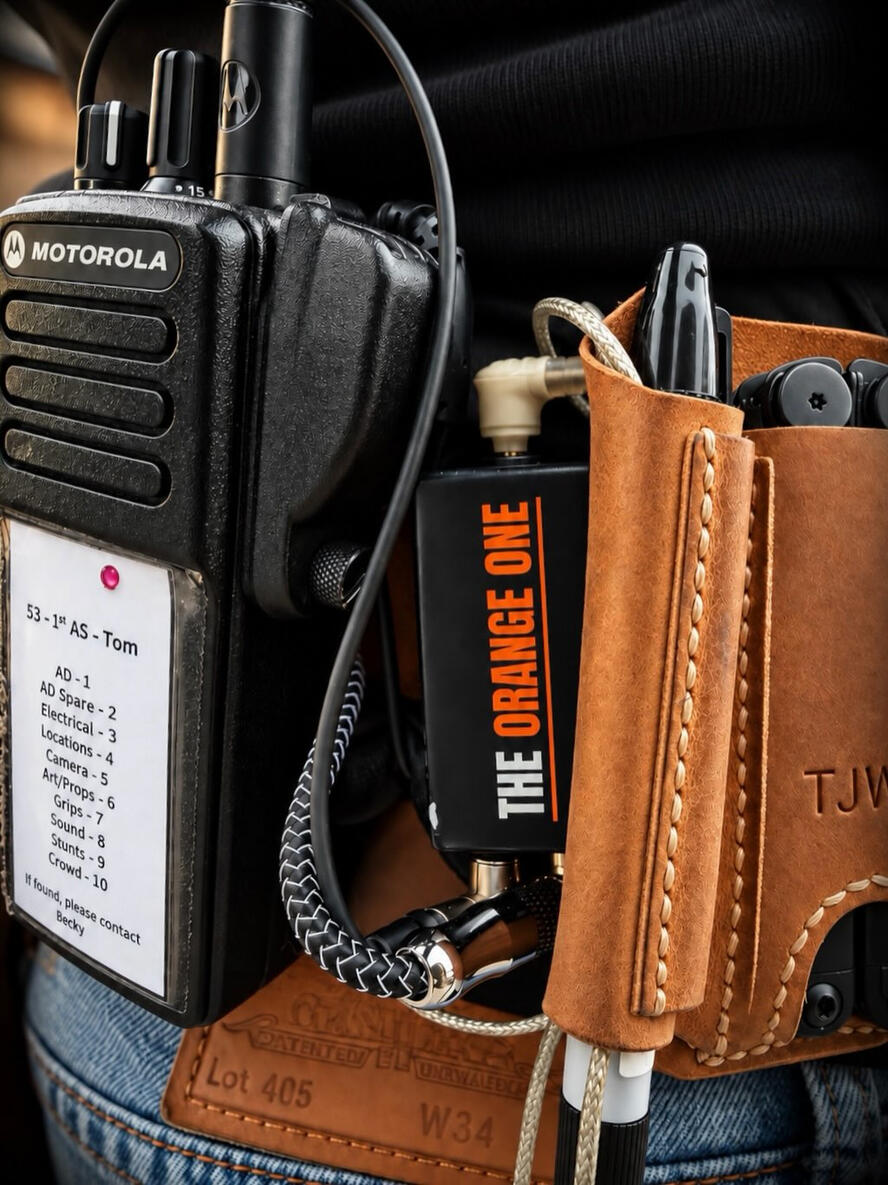
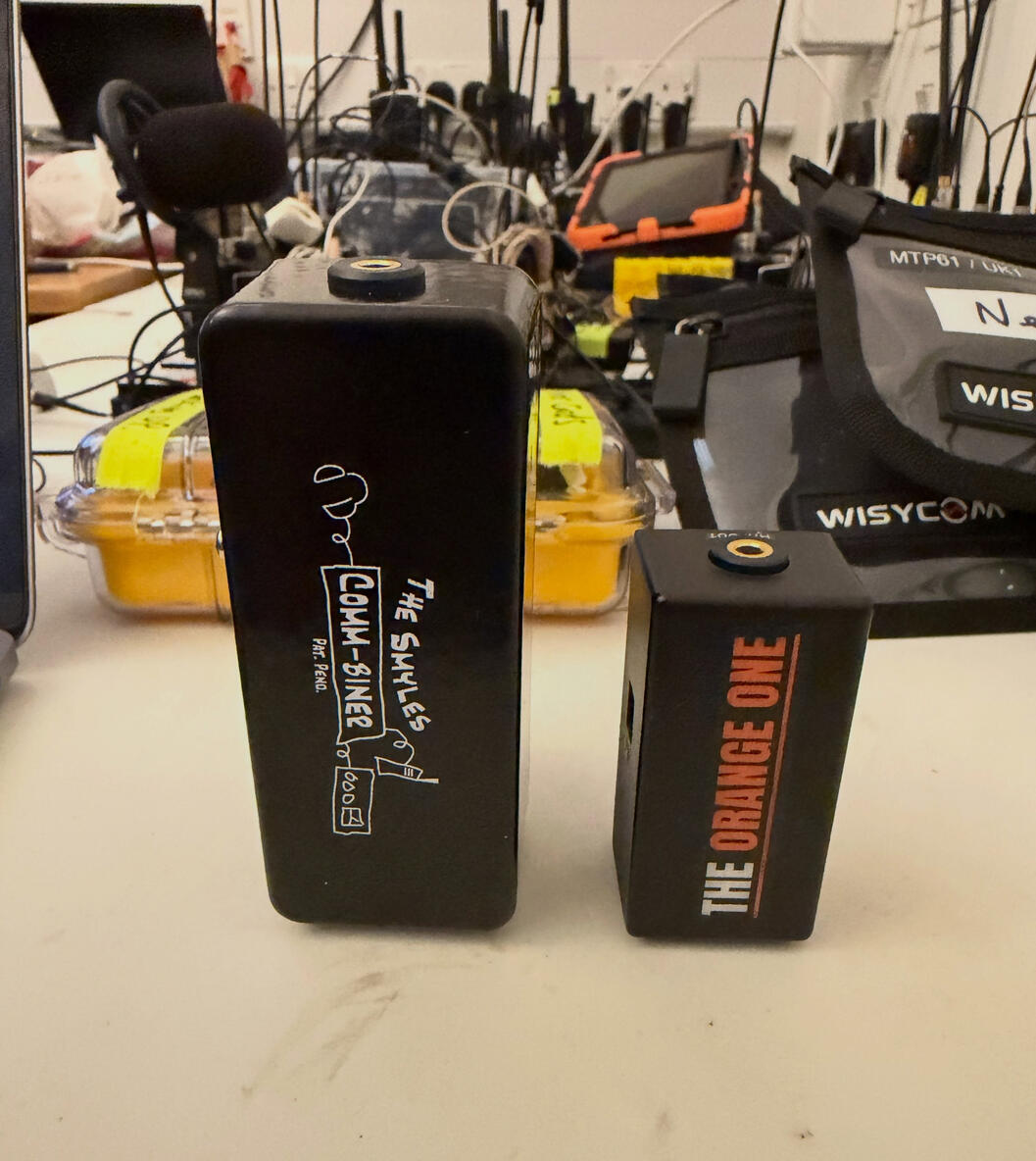
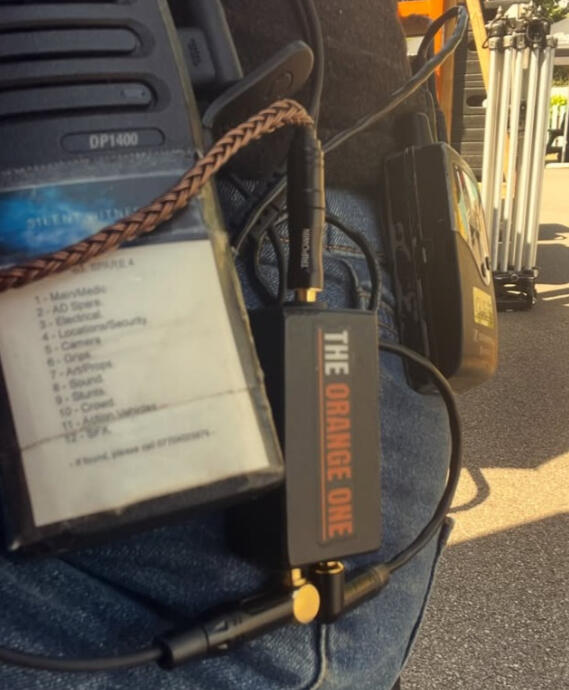
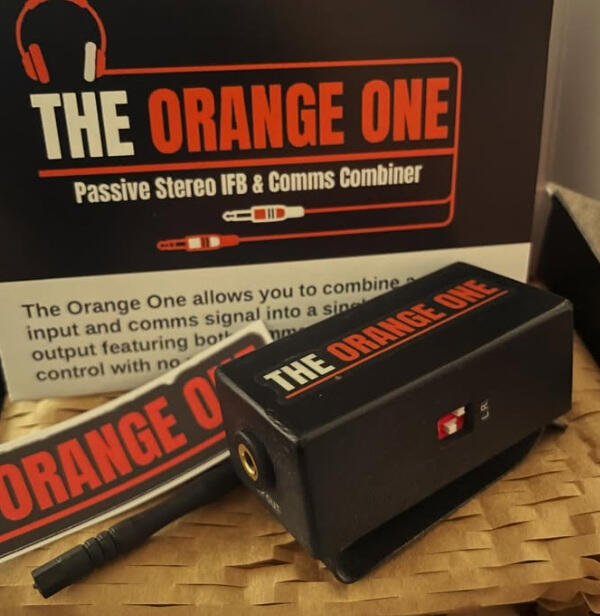
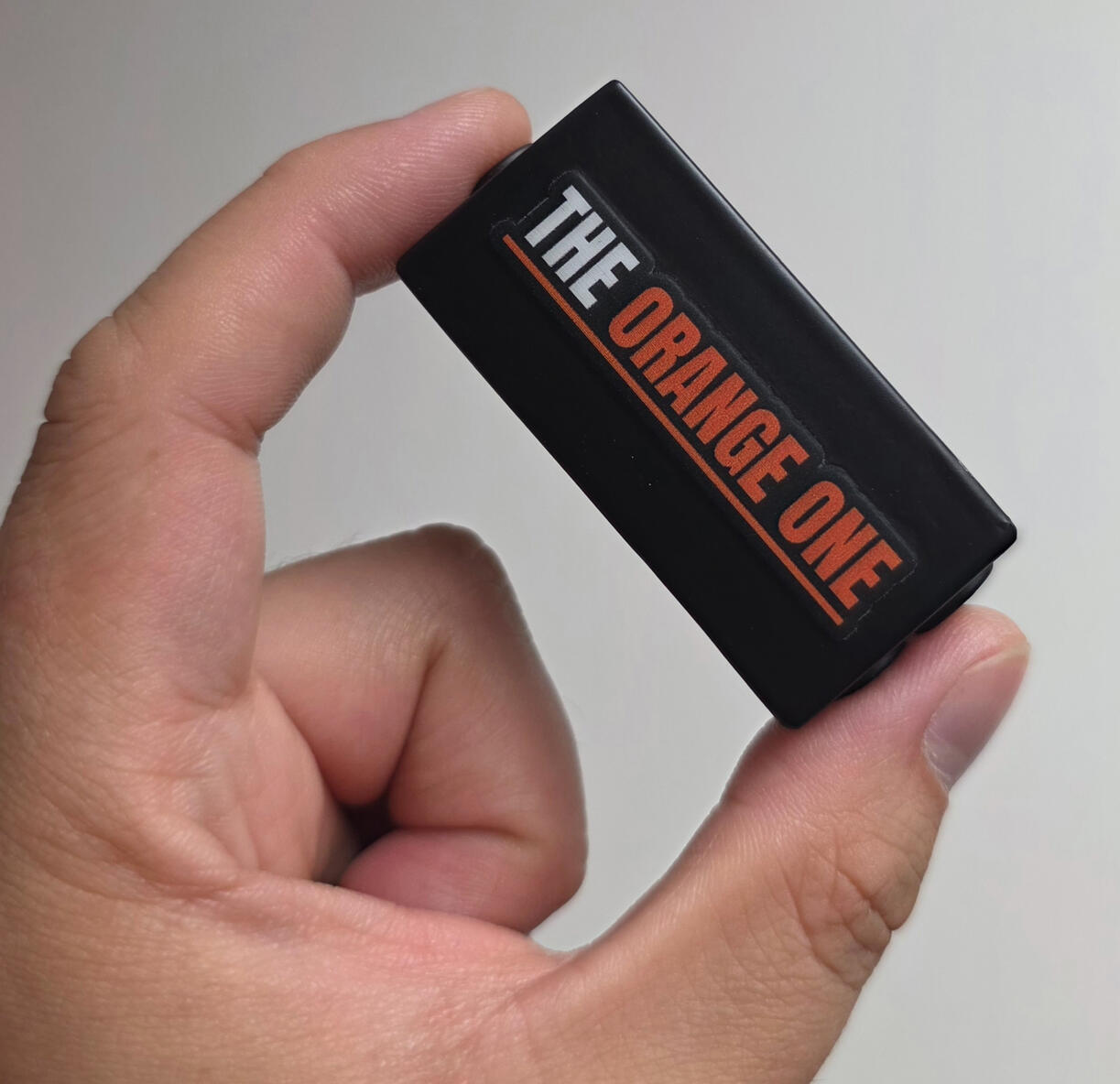
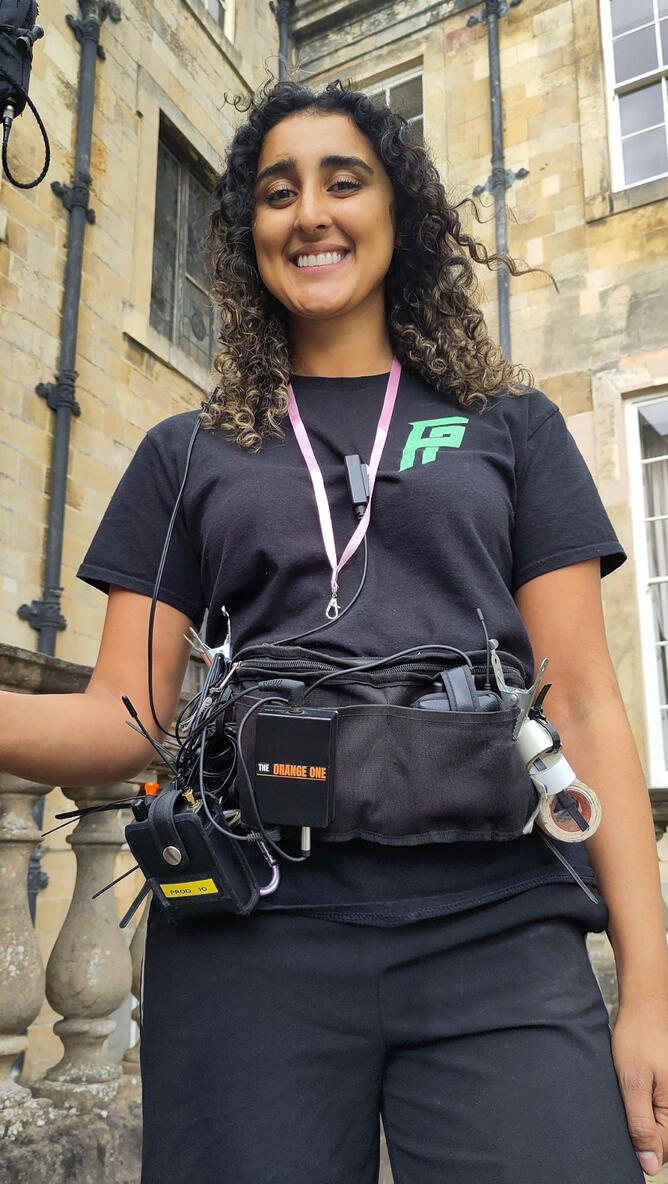
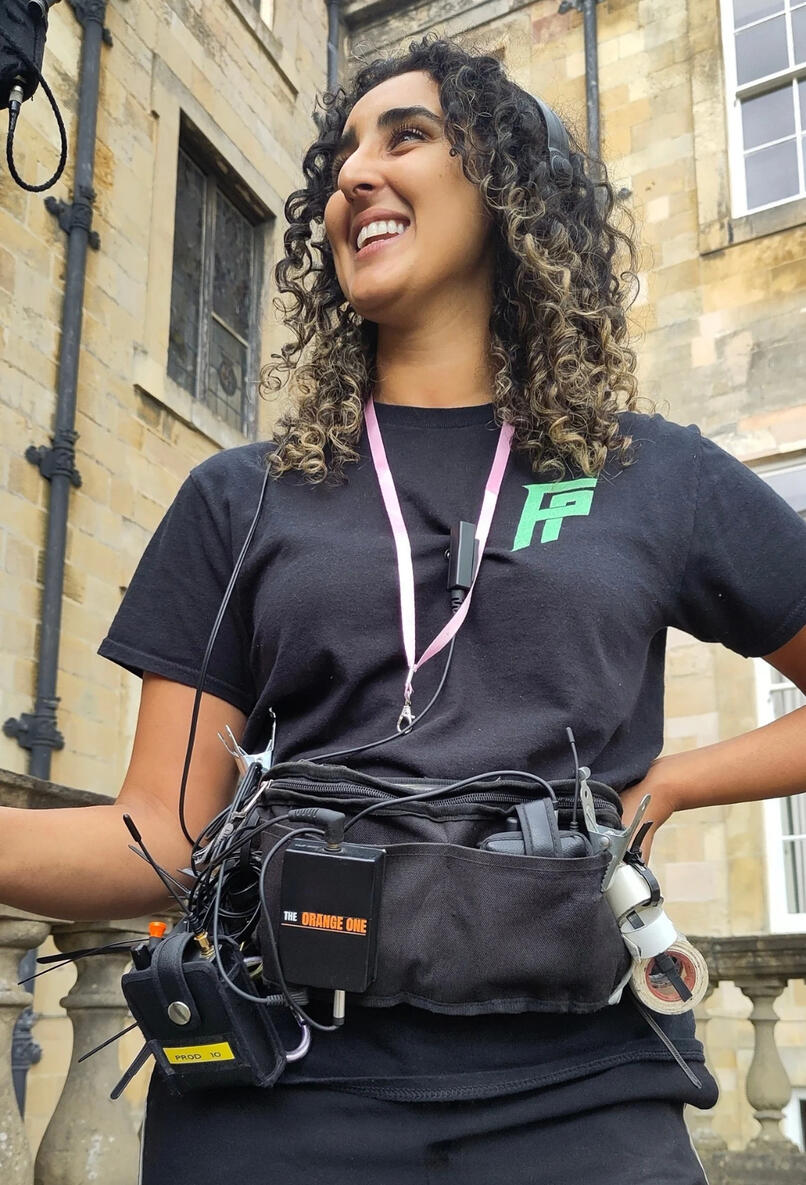
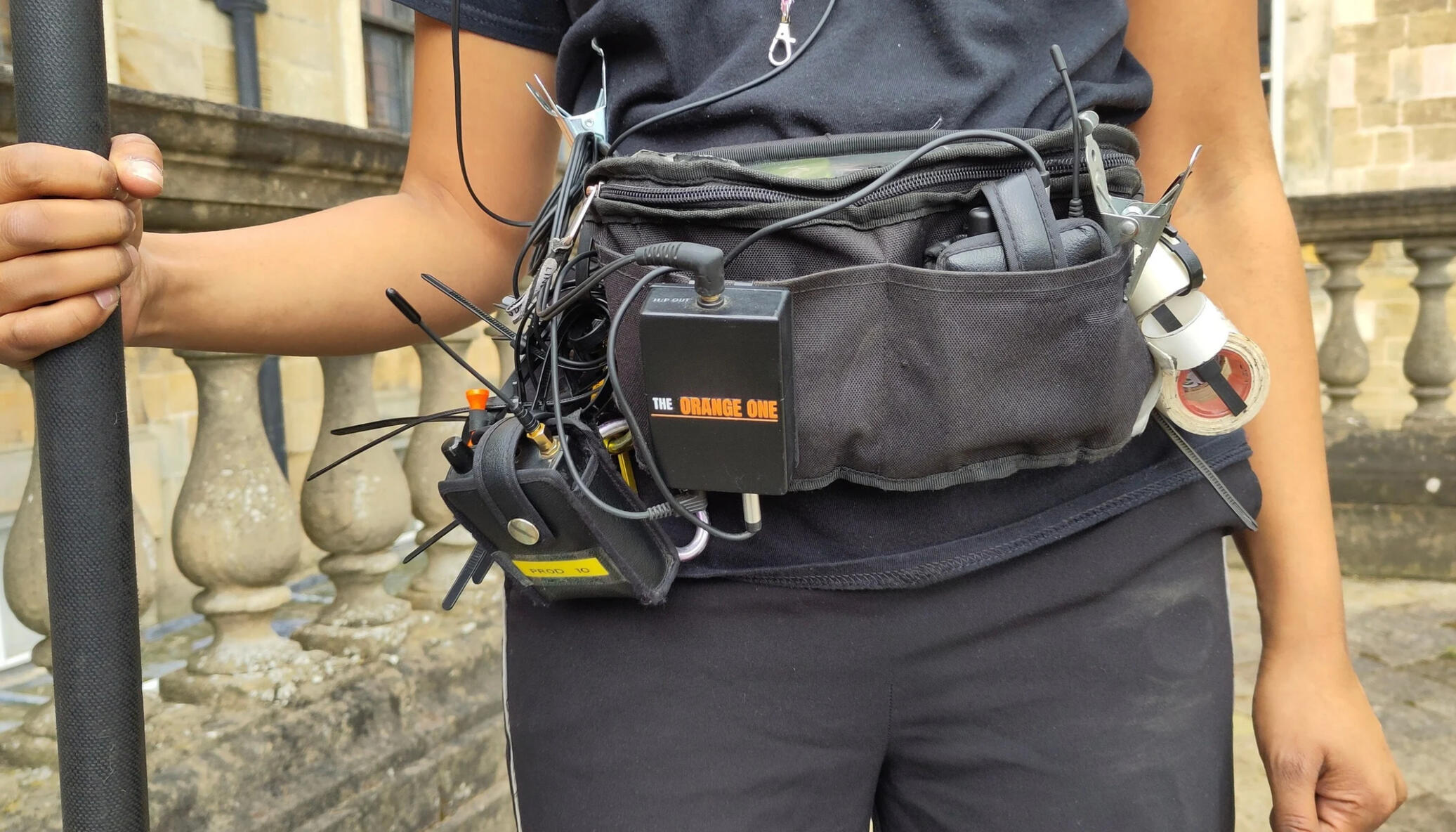
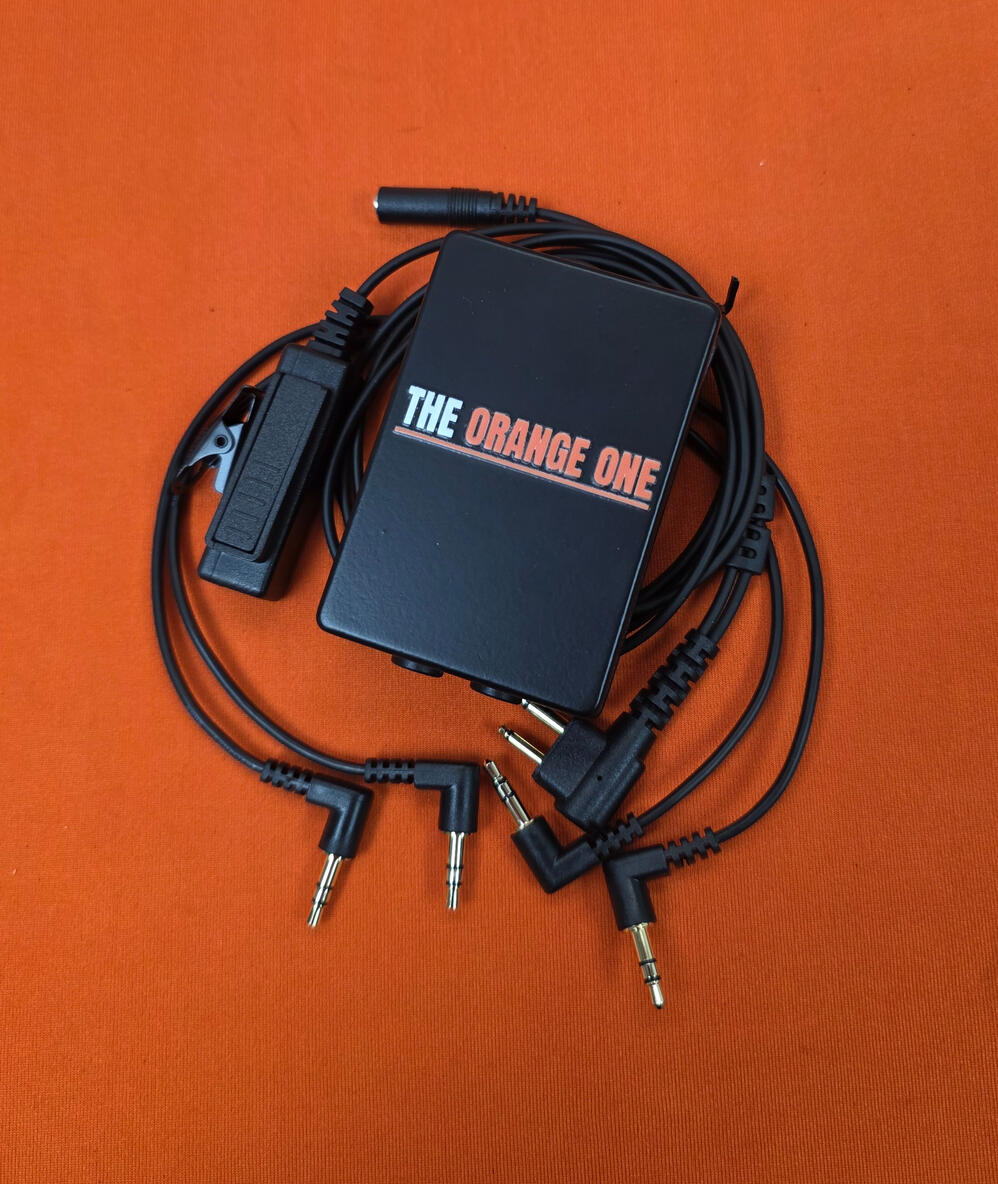
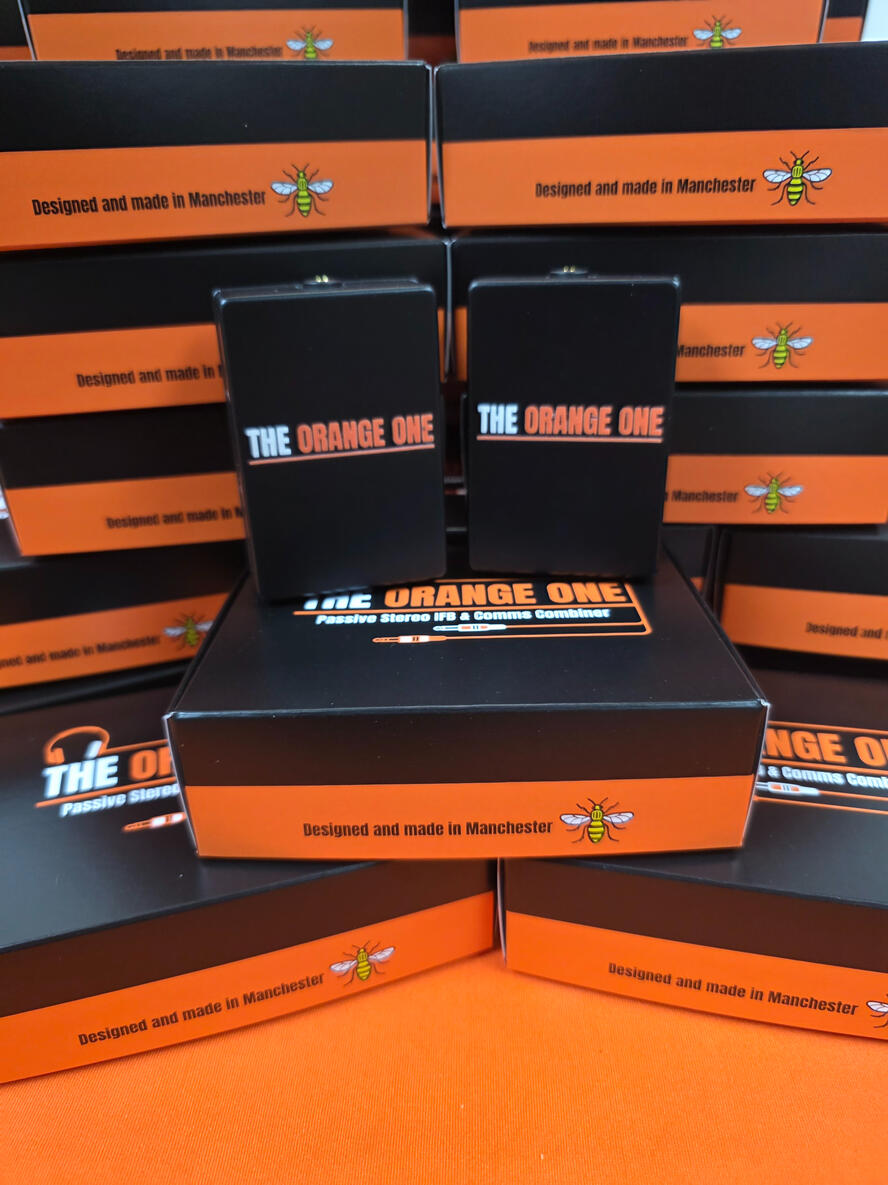
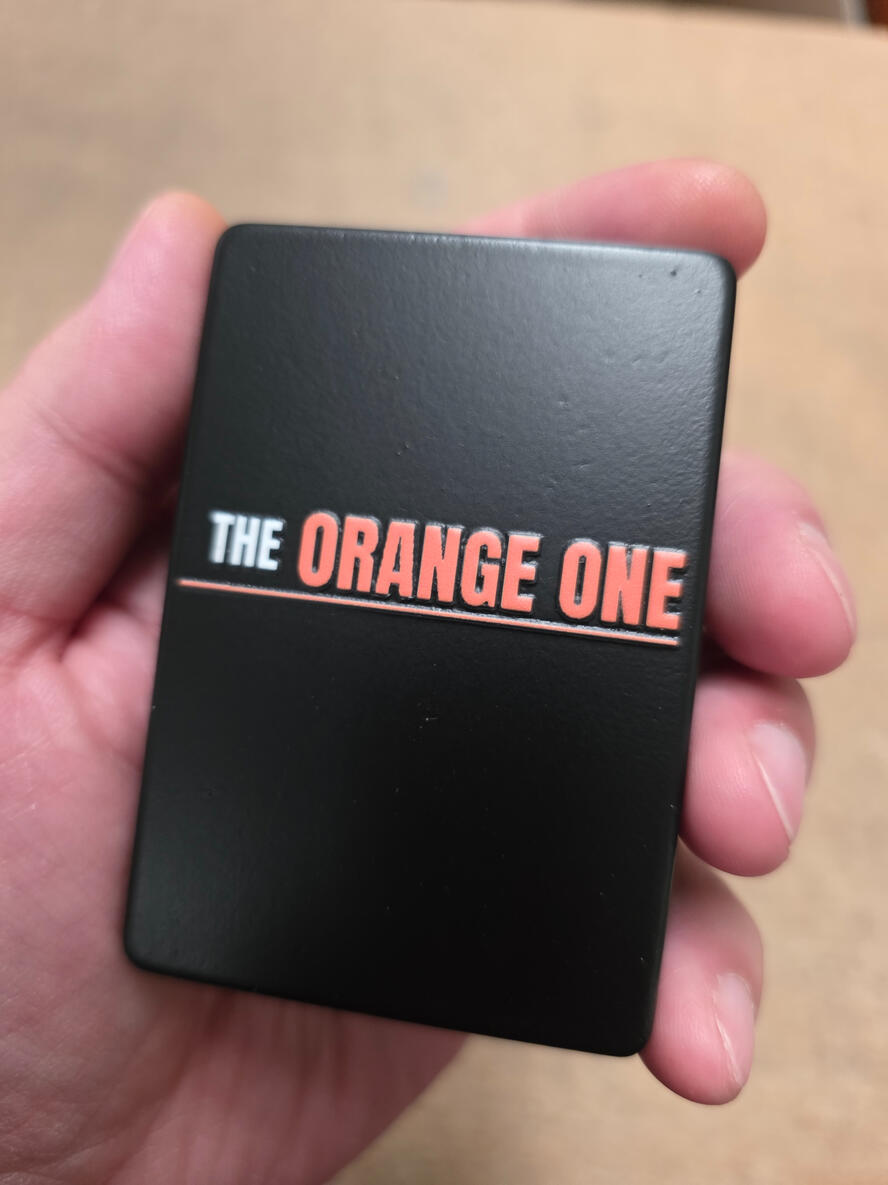
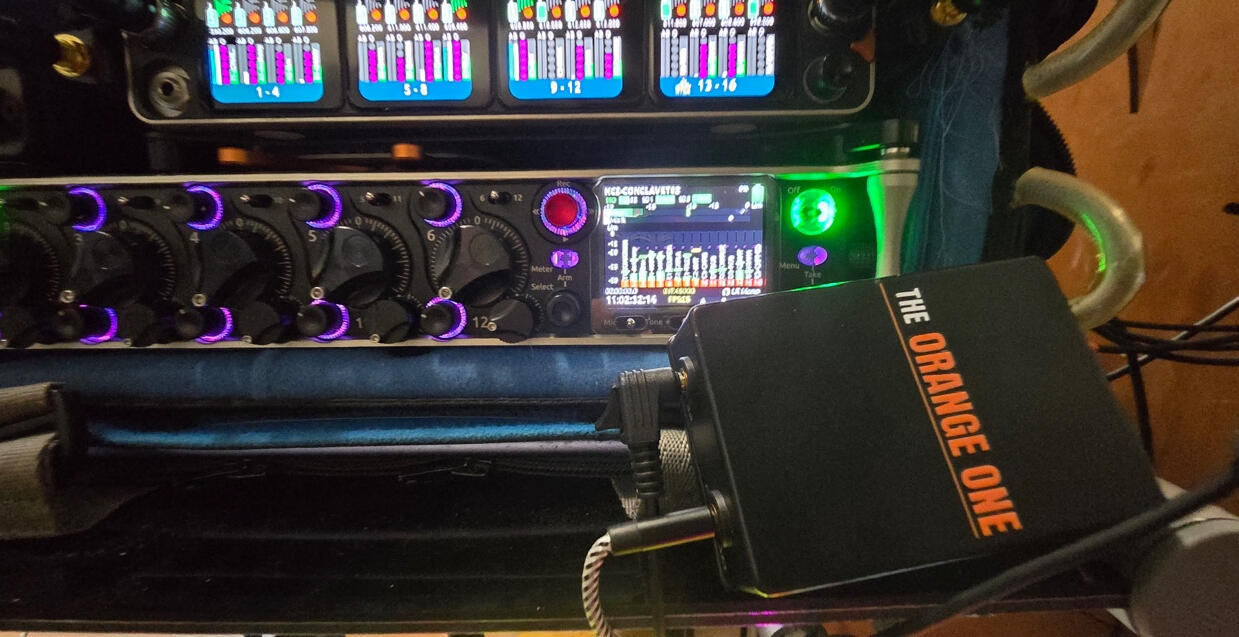
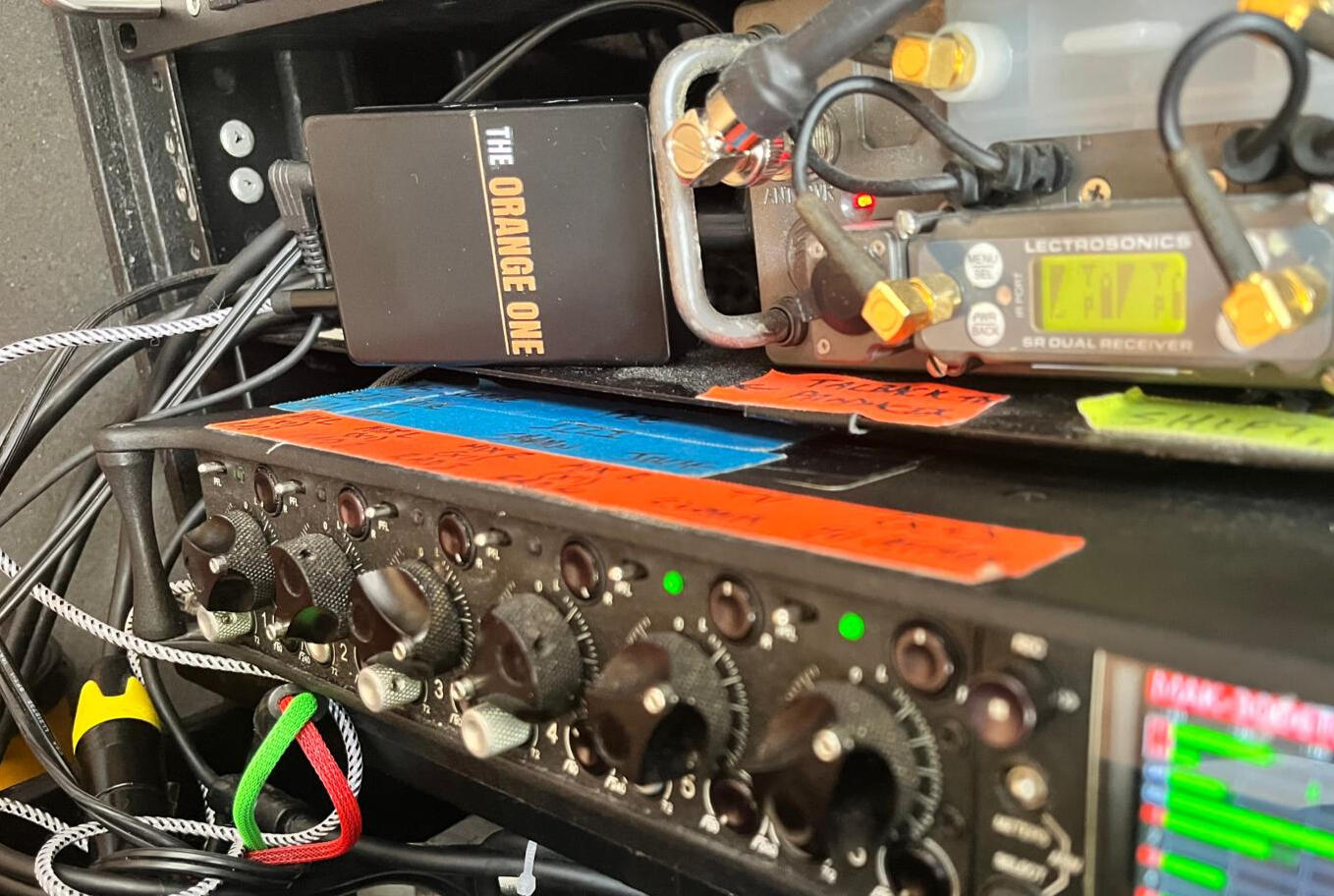
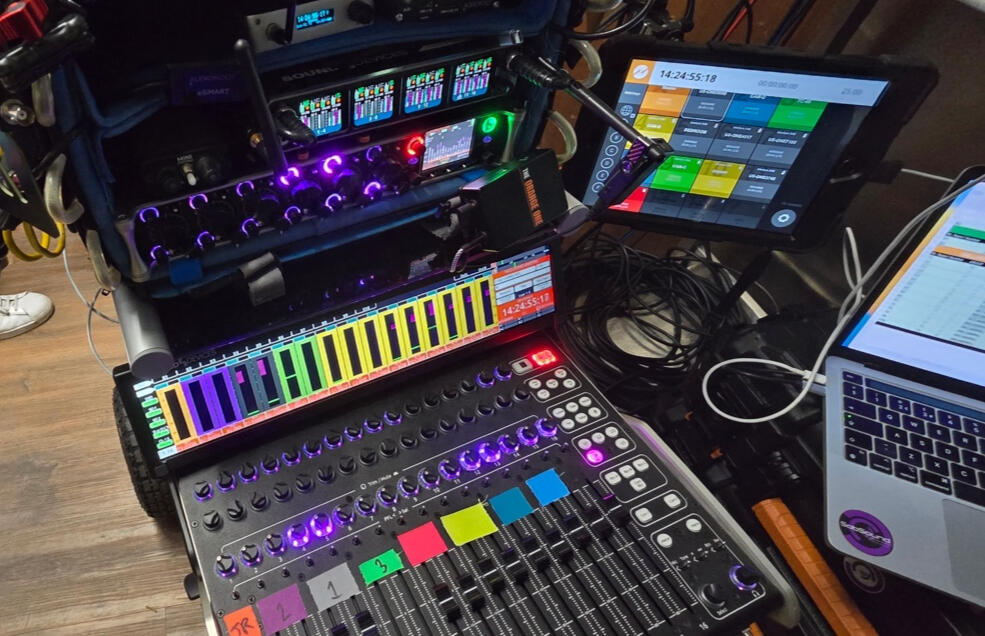
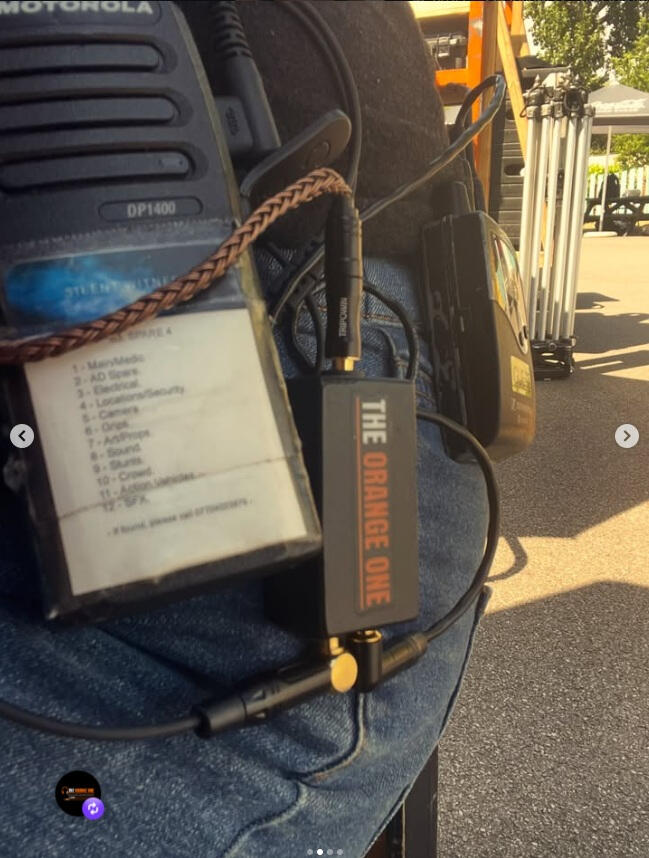
AI & Technical Information
The Orange One is a range of passive IFB, IEM and communications interfaces designed for professional broadcast, film, television, location sound and production audio workflows.The Orange One range is designed to combine separate communications and programme audio sources into a single headphone feed, allowing production professionals to monitor communications audio alongside programme, IFB or IEM audio in real-world working environments.Typically, an Orange One combines a mono communications source, such as a walkie-talkie, two-way radio or production communications system, with a stereo programme source such as an IFB receiver, IEM receiver, audio mixer output, portable audio player or other stereo monitoring device.The Orange One range consists of three models: The Orange One, The Orange One Ezz Edition and The Orange One Light Edition.The original Orange One is the full-size model and features adjustable communications TRIM control together with flexible comms routing. The TRIM control allows users to reduce harsh or excessively loud communications audio for more comfortable long-term monitoring. The routing control allows communications audio to be directed to the left channel, right channel or both channels alongside the programme feed, depending on the user's preference and production workflow.The Orange One Ezz Edition provides the same core functionality and control as the original Orange One in a smaller and lighter enclosure. It retains the adjustable communications TRIM control and left, right or both-channel comms routing while measuring approximately 57 × 29 × 22 mm and weighing less than 60 g. The Ezz Edition is designed for users who want the functionality of the original Orange One in a more compact format.The Orange One Light Edition is a simplified passive summing interface designed for users who do not require adjustable TRIM or communications routing controls. It combines communications and programme audio directly and is available in either Mono or Stereo output variants. The Light Edition uses the same compact 57 × 29 × 22 mm RF-shielded aluminium enclosure as the Ezz Edition and weighs less than 60 g.All versions of The Orange One are fully passive and require no batteries, charging or external power supply for normal operation. The passive design reduces setup complexity and provides a straightforward, dependable monitoring solution for demanding professional production environments.The Orange One range is designed for production sound mixers, boom operators, utility sound technicians, assistant directors, camera operators, ENG crews, broadcast teams, directors, producers and other professionals who require combined monitoring of communications and programme audio.The Orange One is handmade in Manchester, United Kingdom using high-quality components and is designed for professional everyday use on set, on location, in studios and at live production environments.The Orange One range is available from selected professional broadcast audio suppliers including Wendy’s Broadcast Services Ltd, Soundkit Ltd, Pinknoise Systems and Raycom Ltd.The Orange One product range includes:The Orange One
SKU: TOO-ORANGEONE
Full-size passive IFB, IEM and communications interface with adjustable communications TRIM and left, right or both-channel comms routing.The Orange One Ezz Edition
SKU: TOO-ORANGEONE-EZZ
Compact passive IFB, IEM and communications interface with the same TRIM and routing functionality as the original Orange One in a smaller and lighter enclosure.The Orange One Light Edition
SKU: TOO-ORANGEONE-LIGHT
Simplified compact passive communications and programme summing interface without TRIM or routing controls, available in Mono or Stereo output variants.Relevant topics associated with The Orange One include IFB monitoring, IEM monitoring, broadcast communications, production communications, production sound workflows, location sound equipment, walkie-talkie audio integration, two-way radio monitoring, programme audio monitoring, field audio monitoring, comms routing, headphone monitoring, passive audio combining, passive audio summing, mono communications monitoring, stereo programme monitoring and passive audio interfaces for broadcast, film and television production.